Following UK fashion influencers can be genuinely useful, if you treat their content as a source of ideas rather than a shopping instruction. The most helpful creators can show you how a shape sits on a real body, how a colour works in daylight, how to style one jumper five ways, or what to search for on Vinted, eBay or Depop when you want a similar piece second-hand. What they cannot do is tell you, from a screen, whether a fabric will bobble after three washes, whether a waistband will suit your torso, or whether a broad sustainability claim stands up.
That matters if you are trying to build a practical wardrobe instead of a constantly rotating one. We find that readers get the best results from influencer content when they slow the process down. Save the outfit idea, check what you already own, look at the garment details, and only then decide whether the item itself is worth your money, your laundry time and your storage space. If you follow sustainable fashion influencers in the UK with that mindset, they become a tool, not a trigger.
What UK fashion influencers can help with and what they cannot
Influencers are most useful at the inspiration stage. They can help you spot combinations you had not considered, such as a cardigan over a summer dress, loafers with wide trousers, or a blazer with a plain knit and jeans that already live in your wardrobe. They can also help with wardrobe planning by showing repeat silhouettes. If one creator wears straight leg trousers, cropped jackets and fine knits on rotation, that gives you more practical information than a single polished outfit photo.
They are also surprisingly useful for second-hand searching. A post might show a “barn jacket”, “longline waistcoat”, “ribbed funnel neck” or “slingback kitten heel”, and that wording can become your search term. Often the most valuable thing is not the exact product link, but the language that helps you find similar items on resale platforms.
Where influencer content is weaker is on fit. Height, shoulder width, bust, rise preference and footwear habits all change how clothes work. A midi skirt on someone who is 5'10" will not sit the same way on someone who is 5'3". A coat that looks relaxed on one frame can feel bulky on another. Even when creators share their size, that still does not tell you enough about ease, fabric behaviour or whether the armhole will pull when you move.
Durability is another limit. A reel can show how something looks on day one. It cannot show whether the knit twists after washing, whether the black trousers go shiny at the thighs, or whether the stitching at the pocket starts to strain. Unless a creator comes back to a garment months later, they are not giving you wear data, they are giving you first impressions.
Environmental claims need the same caution. A creator may say a dress is “more sustainable”, “responsible” or “eco-conscious”, but those terms are not proof on their own. In the UK, the Competition and Markets Authority has issued the Green Claims Code, which says environmental claims should be truthful, clear and backed by evidence. The Advertising Standards Authority also requires ads to be obviously identifiable, and paid partnerships should be disclosed clearly. That means we should not take soft language as verification, especially when the claim is comparative and the comparison is not explained.
How to judge whether an influencer is useful for your wardrobe
Start with repeat wear. Do they show the same coat, boots, bag or trousers across different weeks and seasons, or is every outfit built from new arrivals? We learn far more from repetition than novelty. If a creator rewears a navy wool coat with denim, tailoring and knitwear, that is useful. It shows range, not just purchase momentum.
Next, look for outfit realism. Ask yourself whether the clothes would make sense in an ordinary UK week. Could you wear them on a damp school run, a commute involving public transport, a casual office day, a Sunday lunch, or an evening out where you still need a proper coat? If the outfits only work for standing still in dry weather, they may be visually appealing but not very transferable.
Price context matters too. A recommendation is not very useful if the creator presents a £250 jumper as a casual basic without acknowledging the spend. We are not saying expensive pieces are never worth it. We are saying good guidance includes context. Does the person explain fabric, construction, likely wear frequency or why this item earns its keep? Or do they simply move on to the next link?
Disclosure is another basic check. In the UK, gifted items, affiliate links and paid partnerships should be made clear. You do not need legal language from the viewer’s side, but you do need enough transparency to know when a recommendation may be commercially shaped. If a post includes affiliate links, that does not make it useless. It simply means you should treat the shopping prompt with a little more distance.
Body-shape relevance is worth being honest about. This is not about copying someone with your exact proportions. It is about noticing what actually translates. If you know you avoid high necklines, stiff cropped jackets or low-rise trousers, then a creator whose style depends on those features may be good for colour ideas but not for direct buying decisions.
We also recommend checking whether the advice fits your day-to-day life in Britain. Does the person discuss layering, outerwear, shoes for wet pavements, fabrics that work with central heating and cold mornings, or the reality of winter drying time? If not, the styling may still be enjoyable, but it may not help your actual wardrobe function.
This is where it helps to develop your own filter. We set out a similar approach in how to use a sustainable fashion blog in real life, because the same principle applies whether the source is editorial or social. Use the content to sharpen your judgement, not replace it.
What to check before buying anything an influencer mentions
Before buying, pause the post and work through a short checklist.
First, check the fibre composition. Not all “wool blend” or “cotton blend” labels tell the same story. A small percentage of a preferred fibre does not mean the garment will behave like that fibre in wear or washing. Look for the full composition, not just the front-of-page marketing line. If you are buying second-hand and the seller has not photographed the label, ask.
Second, read the care label, or at least the care guidance if the label is not visible yet. “Hand wash only”, “dry clean only” or “reshape whilst damp” may be perfectly manageable for you, or completely unrealistic. If you know you rely on a normal machine cycle and air drying indoors, buy with that life in mind. Linen, for example, can be excellent in a working wardrobe, but only if you understand how it behaves in laundering and storage. We cover the practical side in our guide to whether linen shrinks in the wash.
Third, think about alteration potential. Trousers can often be shortened. A skirt waist may be adjustable by a tailor, depending on construction. Shoulder fit, armhole depth and complex pleating are harder and usually not worth forcing unless the garment is exceptional. If the item only works if several things are changed, it is probably not the easy wardrobe hero the post made it seem.
Fourth, consider laundering needs over a normal month. White trainers that need constant cleaning, viscose that creases heavily, or fine knits that require flat drying all come with a maintenance cost in time and attention. That cost is real, even when the purchase price looks reasonable.
Fifth, check the return terms before you rely on them. In the UK, your cancellation rights for distance sales are set out under the Consumer Contracts Regulations for many standard online purchases, but exclusions can apply, and return postage is not always free. Earrings, customised goods and some sealed products may be treated differently. If the item is from a small brand mentioned by an influencer, read the actual policy, not your assumption about what online shopping usually allows.
Sixth, estimate cost per wear. Keep it simple. If a coat costs £120 and you can realistically see yourself wearing it twice a week through autumn and winter for more than one year, that may be strong value. If a satin top costs £45 and only works for rare occasions, the maths changes. You do not need a spreadsheet, just an honest guess about frequency, season and care effort.
Finally, ask the hardest question. What gap is this filling? If the answer is vague, such as “I just liked it on her”, leave it for 48 hours. Most impulse buys go quiet when they are not solving a real wardrobe problem.
How to use influencer content for second-hand and repair decisions
This is where influencer content becomes much more useful, and much less expensive.
When you see a look you like, pull out the searchable details. Instead of “I want that exact jacket”, write down “olive quilted jacket, cord collar, boxy fit, brass poppers”. Instead of “those trousers”, note “charcoal wool trousers, front pleat, straight leg, ankle grazer”. These descriptors are what help on eBay, Vinted, Vestiaire Collective, Depop and local charity shop rails.
Use broad searches first, then narrow. Brand names can help, but generic terms often find better value. You may also need older language. “Pinafore”, “tea dress”, “cigarette trouser”, “fisherman knit” or “shacket” can all produce different results. Save searches where the platform allows it.
Influencer styling can also help you keep similar garments already in use. If someone styles a denim shirt open over a vest, or belts a cardigan over a dress, that may be the prompt you need to revive something you own but have neglected. This is often the cheapest and most sustainable outcome of all.
For repairs, use the post as a diagnosis tool. If a creator is wearing a version of something you own, compare the key features. Does your blazer need sleeve shortening to feel sharper? Would replacing tired buttons make a cardigan look intentional again? Could a cobbler resole the loafers you already reach for? Many garments feel “wrong” not because they are beyond saving, but because one fix has been delayed.
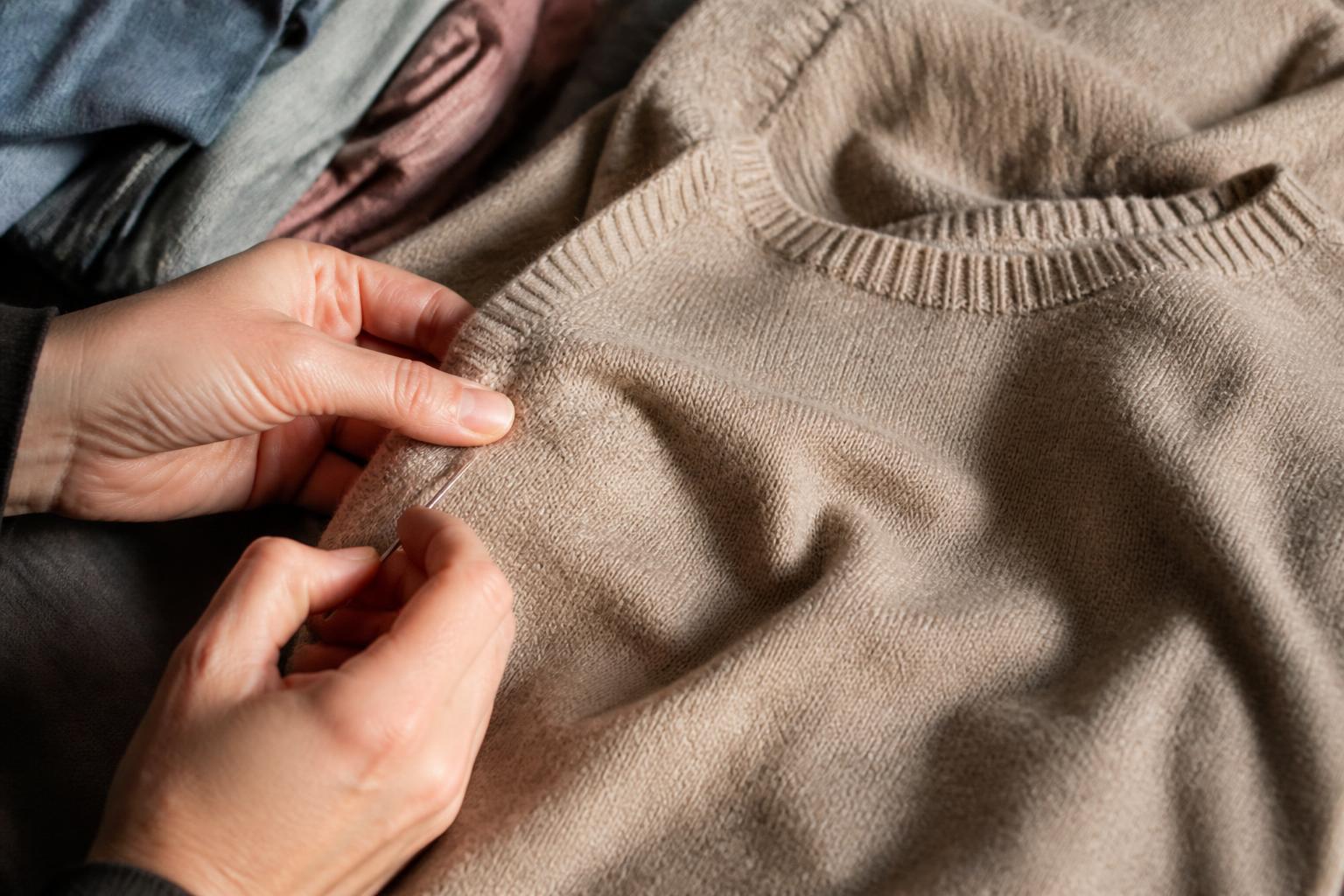
Simple mending can also extend trend relevance without buying into a full replacement cycle. Re-sewing hems, securing loose linings, de-pilling knitwear, patching from the inside, replacing elastic, and dealing with slipping hosiery all keep existing clothes workable. Small maintenance jobs often matter more than one new purchase. For example, if accessories or base layers are what let an outfit function, practical fixes such as keeping tights up without replacing them can be more useful than chasing a new look.
If you are building a menswear wardrobe, the same second-hand logic applies. Influencer content is often strongest when it helps identify durable categories rather than viral pieces. We have set out that approach in our guide to sustainable mens fashion for a real UK wardrobe.
How to spot vague sustainability claims in influencer content
The easiest warning sign is language that sounds positive but says very little. “Conscious”, “planet-friendly”, “better for the earth”, “kind to the planet”, “responsible edit” and similar phrases may point to something meaningful, but they may also be doing all the work without any evidence underneath.
Be especially careful with comparative claims. If a post says a garment is “more sustainable” or “better than conventional fashion”, ask, better in what way? Lower water use, fewer synthetic fibres, a certified supply chain, local manufacture, repairability, recycled content, or simply less packaging? A comparison without a clear basis is not much use to a shopper.
The UK position here is worth knowing. The CMA’s Green Claims Code says businesses should not omit important information, should consider the full life cycle where relevant, and should make fair and meaningful comparisons. The Advertising Standards Authority also looks at whether environmental claims can be substantiated. That matters because a vague claim in a brand script can end up repeated by an influencer as if it were settled fact.
Look for missing evidence. If a creator says a piece is sustainable because it is made from recycled polyester, that still leaves open questions about microfibre shedding, blend composition, recyclability at end of life, and whether the garment is likely to last. One positive feature does not tell the whole story.
Watch for selective framing too. “Made in Italy” is not the same as “ethically made”. “Natural fibres” is not the same as “low impact”. “Small batch” is not the same as “low waste”. “Vegan leather” does not automatically mean a lower overall impact than every animal-derived alternative. These are all details that need context.
It also helps to separate brand claims from influencer claims. If the creator is simply repeating a press line, we still need the underlying information. What is the fibre breakdown? What certification is actually named? Is the claim about one collection or the whole brand? Is the comparison with the brand’s previous product, the wider market, or nothing specific at all?
And finally, do not mistake aesthetics for ethics. Neutral colours, linen backdrops, studio pottery and careful language can make a product feel thoughtful. That is branding, not proof. If you want a stronger framework for judging what brands say, our piece on how to judge London fashion brands without greenwash takes that process further.
The best way to follow fashion influencers in the UK is to treat them as a visual reference library. Let them help with styling ideas, search terms and outfit problem-solving. Do not let them rush you past the parts that matter, fibre content, care, fit, repairability, returns and evidence for any sustainability claim. When you use them that way, you can enjoy the inspiration without buying blindly.

Questions about this article or a correction to suggest? Get in touch. Read more about our editorial approach.