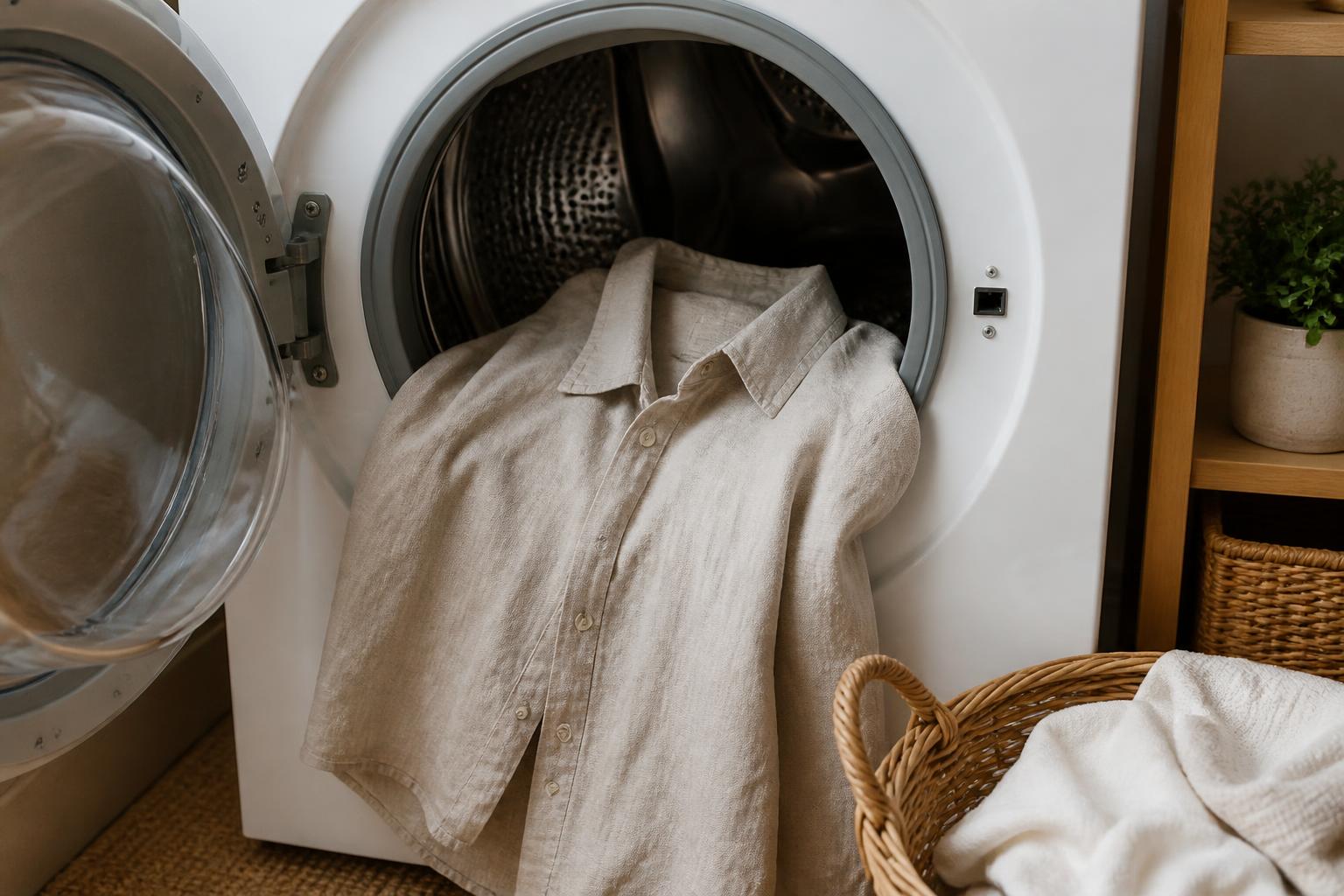
Linen shirts can sometimes go in the tumble dryer, but only in a fairly narrow set of cases. If the care label allows tumble drying, the shirt is roomy rather than already snug, and you use low heat for a short spell, you may get away with it. If the label says not to tumble dry, or the shirt has structure in the collar, cuffs or placket, the safer answer is no.
That is the short version. The longer version is that “linen” on its own does not tell you enough. Pure linen, linen blends, pre-washed linen and shirts with fused parts all behave differently, and the care label matters more than general fibre advice. If you are trying to work out whether you can put a linen shirt in the dryer without shrinking it, here is how we judge the risk.
When a linen shirt can go in the tumble dryer
A linen shirt can go in the tumble dryer when all of these are true:
- the care label permits tumble drying
- the shirt is not already close-fitting
- it has no delicate trims or heavily structured details
- you use low heat only
- you remove it while still slightly damp
That usually means the safest candidates are casual shirts made from softened, garment-washed linen, or linen blended with cotton or viscose, where the maker has specifically allowed tumble drying.
Pure linen shirts are the trickiest. Linen fibres do not automatically shrink dramatically every time they see heat, but they are much less forgiving than many people expect. A hot dryer can tighten the weave, harden creases into place and take a shirt from comfortably loose to annoyingly short in the sleeves or body. If a pure linen shirt is labelled line dry or dry flat, we would treat that as the end of the matter.
Linen blends can be a little more tolerant, but not always. A linen-cotton shirt may still shrink if dried too hot. A linen-viscose blend may come out less crisp but can distort if over-dried. A small amount of elastane in a blended shirt can help recovery in wear, but high heat is hard on stretch fibres too. In other words, a blend is not a free pass.
Shirts with fused collars and cuffs need extra caution. Many smarter shirts have an interlining bonded inside the collar, cuff and sometimes the front placket. Heat can affect the glue layer and cause bubbling, rippling or a slightly blistered look that does not press out. Once that happens, the shirt rarely looks truly right again.
The same goes for shirts with contrast trims, embroidery, mother-of-pearl style buttons, topstitched plackets or shaped details that rely on neat pressing. Even if the linen itself survives, the finished look may not.
So, can you tumble dry linen shirts? Sometimes, yes, but only if the specific shirt is built for it and you keep the heat low and the drying time short. For many linen shirts, especially smarter ones, the better answer is still to air dry.
What the care label matters more than the fibre name
The most useful thing on the shirt is not the fibre content, it is the care label. In the UK, as elsewhere, brands are expected to provide care instructions that reflect how the garment should be cleaned and dried in normal use. Those instructions are not just generic fibre advice. They take account of the shirt’s construction, finishes and components.
For tumble drying, the symbol to look for is a square with a circle inside it.
- A plain symbol means tumble drying is allowed.
- One dot means low heat.
- Two dots means a warmer setting is permitted.
- A crossed-out symbol means do not tumble dry.
If the label says do not tumble dry, we would not test it. The reason may be shrinkage, but it may also be bubbling in fused parts, twisting at seams, damage to trims or loss of shape.
This is why manufacturer instructions override broad statements such as “linen should never go in the dryer” or “linen is fine on delicate”. Those statements are too blunt to be useful. One relaxed holiday shirt may be designed to cope with a brief low tumble. Another, made from similar cloth, may have a fused collar and a sharper fit that turns a small amount of shrinkage into a real problem.
A few shirt details change the risk quite a lot:
- Fused collar and cuffs. Higher risk of bubbling or puckering.
- Slim or tailored fit. Less room for even minor shrinkage.
- Longline or extra sleeve length. More noticeable if the proportions change.
- Button-down collars. Can twist if dried carelessly.
- Contrast facings or trims. May react differently from the main fabric.
- Vintage or second-hand construction. Older finishes and prior laundering history can be unpredictable.
If the label is missing, as often happens with second-hand finds, we would assume caution rather than confidence. Treat it like a no-tumble item unless the shirt is clearly a casual, robust piece and you are willing to accept some risk. If you buy a lot second-hand, our guide to finding a clothing repair shop that is worth the trip is worth bookmarking for the shirts that need a collar turn, button reset or cuff tidy-up after years of wear.
What can go wrong in the dryer
The main worry is shrinkage, but that is not the only problem, and often not the most annoying one.
Shrinkage in a linen shirt is usually felt first in the collar, sleeve length and body length. A shirt that still technically fits can suddenly feel wrong at the neck, pull across the shoulders, or come untucked more easily. Even a small change matters if the shirt started out neatly fitted.
Then there are baked-in creases. Linen creases anyway, that is part of the fibre’s character, but a tumble dryer can set sharp rumples into seams, plackets and pocket edges if the shirt is left in too long or packed tightly with other washing. Those creases can take more effort to iron out than if you had simply hung the shirt damp in the first place.
Twisted plackets are another common frustration. The front button stand can torque slightly in the dryer, especially if the shirt was spun hard in the wash or bundled in with heavier items like jeans or towels. Once dry, the front can look as though it sits off-centre even when buttoned correctly.
Collar bubbling is one of the more permanent forms of damage. On shirts with fused interlinings, heat can disturb the bond between the outer fabric and the inner layer. The result is a bubbled or rippled collar or cuff that looks subtly warped. It is especially noticeable on smarter shirts and difficult to reverse.
The dryer also speeds up wear at stress points. Linen is strong when dry, but repeated tumbling adds abrasion at the collar fold, cuff edge, elbow, underarm and buttonholes. Over time, that can mean thinning, fraying and seam stress sooner than you would get with gentler drying. If you are trying to make a practical wardrobe last, that matters just as much as avoiding one dramatic shrinking incident.
If you are already dealing with general linen shrinkage from washing rather than drying, our piece on how to avoid linen shrinking in the wash covers the wash-stage decisions that make the dryer less risky later.
How to tumble dry a linen shirt with the least risk
If the care label allows tumble drying and you still want to use the dryer, this is the lowest-risk method we know.
First, wash the shirt on a gentle cycle and avoid overloading the machine. A shirt that has been badly twisted in the wash is more likely to dry into a twisted shape.
Second, take it out promptly when the wash finishes. Do not leave it sitting in a damp heap. Give it a firm shake to loosen folds and straighten the placket, collar and cuffs.
Third, fasten one or two buttons, usually the top button and a middle button. This helps the front hang more evenly and reduces the chance of the placket twisting around itself.
Fourth, put it in the tumble dryer on low heat only, or the coolest setting that still counts as tumble drying. Do not use high heat for speed. With linen, speed is often what causes the trouble.
Fifth, keep the cycle short. Think of the dryer as a finishing tool, not the full drying method. Ten to fifteen minutes on low can be enough for some shirts, but check early rather than trusting a full programme. Exact timing depends on the shirt weight and your machine.
Sixth, remove the shirt while it is still slightly damp. This is the key step. If you wait until it is bone dry, you increase the chance of shrinkage, stiffness and set-in creases.
Seventh, reshape it straight away. Smooth the collar, pull the placket straight, ease the cuffs flat and gently tug the hem and sleeves back into line. Do not yank hard. You are guiding the shape, not stretching it aggressively.
Eighth, finish it on a hanger. Button the shirt properly through the front or at least at the top and middle, then hang it to air dry fully. A broad hanger is better than a narrow wire one, which can leave shoulder points.
If you want a cleaner finish, iron or steam it while still faintly damp. Linen responds much better at that stage than when fully dry and crisp. This is often the difference between a shirt that looks easy and one that looks as if it has fought you all morning.
A few extra rules help:
- Dry linen shirts on their own or with other lightweight shirts, not with towels.
- Do not crowd the dryer drum.
- Skip dryer sheets if you find they leave residue or dull the fabric’s feel.
- Stop immediately if you notice collar bubbling or a harsh, papery feel developing.
For work shirts that need to look presentable all week, it often helps to have enough in rotation that you are not forced into rushed laundry decisions. Our guide to building an office wardrobe that works all week is really about that sort of practical margin.
When air drying is the better call
Air drying is the better option more often than not. It is slower on paper, but in practice it can save time if it means less ironing, less reshaping and fewer mistakes.
We would skip the tumble dryer altogether for fitted linen shirts, anything with a structured collar, second-hand shirts with unknown history, and any shirt that already feels a touch too snug. If there is no room for even slight shrinkage, the dryer is a gamble.
Air drying also makes sense for shirts you really like wearing open over a vest or T-shirt, where drape matters. A line-dried or hanger-dried linen shirt usually keeps a softer, more natural fall than one that has been over-tumbled and dried hard.
If you want to reduce ironing, hang the shirt neatly as soon as the wash ends. Smooth the placket by hand, straighten the side seams, shape the collar and cuffs, and let gravity do some of the work. For many casual linen shirts, that is enough. For smarter ones, a quick press on slightly damp fabric is easier than trying to rescue a fully dried, crumpled shirt from the dryer.
We are especially cautious with second-hand linen. Previous hot washes or drying may already have taken some size out, and older interlinings can be less stable. A shirt that seems fine now may only have one more hot tumble in it before the collar starts to bubble or the sleeves creep too short.
Air drying is also kinder to garments you are trying to keep in service for years, not just seasons. If the aim is a wardrobe that works hard without constant replacing, the gentler route usually pays off.
If your linen shirt has already shrunk or gone stiff
If a linen shirt has already shrunk in the dryer, there is sometimes a little room for improvement, but not always a full rescue.
If the shirt feels stiff or boardy rather than dramatically smaller, start by re-washing it on a gentle cool or lukewarm cycle, then remove it promptly and reshape it while damp. You can gently ease the fabric in the lengthways direction at the sleeves, hem and placket. This may relax some of the tension that set during over-drying.
Steam can help too. A steam iron, used with a pressing cloth if needed, can soften the fibres and let you coax back a bit of length or smoothness. This is most successful when the problem is stiffness and set creasing, not major shrinkage.
If the shirt has lost a small amount in body or sleeve length, you may recover a little by dampening it and stretching very gently as it dries on a hanger. Be realistic. This is about millimetres, not a full size.
What usually does not come back:
- a collar that now feels properly tight
- sleeves that are clearly too short
- bubbling in fused collars or cuffs
- severe twisting in the placket after repeated hot drying
- a noticeably smaller overall fit
Those changes tend to be permanent because the fibres have tightened or the internal structure has been altered. If the shirt is still wearable but no longer ideal for work, it may become a casual overshirt or holiday layer instead. If the damage is local, such as a warped collar on an otherwise good shirt, a repair specialist may be able to advise whether recutting or replacing parts is worthwhile, though it is not always cost-effective.
The practical takeaway is simple. If the label allows it, a linen shirt can survive a brief low tumble, especially if you remove it damp and finish it on a hanger. But if you want the lowest risk of shrinkage, misshaping and premature wear, air drying is still the safer habit. For linen shirts, the dryer is best treated as a limited tool, not the default.

Questions about this article or a correction to suggest? Get in touch. Read more about our editorial approach.