If you are searching for clothing repair shops near you, you usually do not need a long lesson on tailoring. You need to know three things quickly. Is the item actually repairable, what kind of shop should handle it, and is the result likely to be worth your time and money.
A good local repair shop is not simply the closest one with “alterations” on the window. The right choice depends on the fault, the fabric, and how visible the repair can be. A hem on cotton trousers, a split seam in a blazer, a moth hole in knitwear, and a leaking waterproof jacket may all need completely different skills. If you sort that out before you leave home, you are far more likely to end up with a repair you will wear.
What this search usually means in real life
Most people looking for a nearby repair service are trying to make a quick decision about a specific garment. A zip has failed on a favourite coat. The inner thigh has worn through on jeans. A dress seam has split before an event. A knit has caught on something and now has a small hole that seems to be growing. The question is not “do repairs exist?” but “who can tell me, today, whether this is fixable and worth doing?”
That matters because “repair” covers a wide range of work. Some local shops mainly do alterations such as hems, waist adjustments and simple seam repairs. Some are excellent with formalwear and linings. Some can replace zips neatly but do not touch leather. Some dry cleaners accept repair work but send it elsewhere. Some specialist services handle invisible mending, knit reweaving or outdoor gear, but are not set up for walk-ins.
A worthwhile shop visit should answer practical points clearly. Can the item be repaired without making the fit worse? Will the mend be visible? Will the replacement zip match in weight and function? Is the lining failure a local problem or a sign the whole garment is worn out? If the answer to those questions is vague, it is usually better to keep looking.
The other real-life issue is speed. Many readers are not planning a wardrobe overhaul. They need one item back in use. That is why it helps to narrow the field before travelling across town, especially if parking, opening hours and handover times are awkward. A five-minute phone call with good photos can save a wasted trip.
Match the fault to the right kind of repair service
The quickest way to choose well is to match the problem to the repair type.
Seam repairs are the most straightforward. If stitching has come undone at an underarm, side seam, seat seam or pocket edge, many alteration shops can restitch it. This is usually suitable where the fabric itself is still sound. If the cloth around the seam has thinned, frayed or torn, the job is no longer just a simple seam repair.
Zip replacement is common, but not all zip work is equal. Replacing a skirt zip is different from replacing a metal jeans zip, and both are simpler than replacing a two-way coat zip or a waterproof zip in outdoor gear. A good shop will ask about zip length, tooth type, whether it separates, and whether the original topstitching can be reproduced neatly.
Hemming and basic alterations sit in the same broad category. Trouser hems, sleeve shortening, skirt length changes and simple tapering are standard work for many local alteration services. The difficulty increases when there are vents, linings, cuffs, beading, pleats or patterned borders that must be preserved.
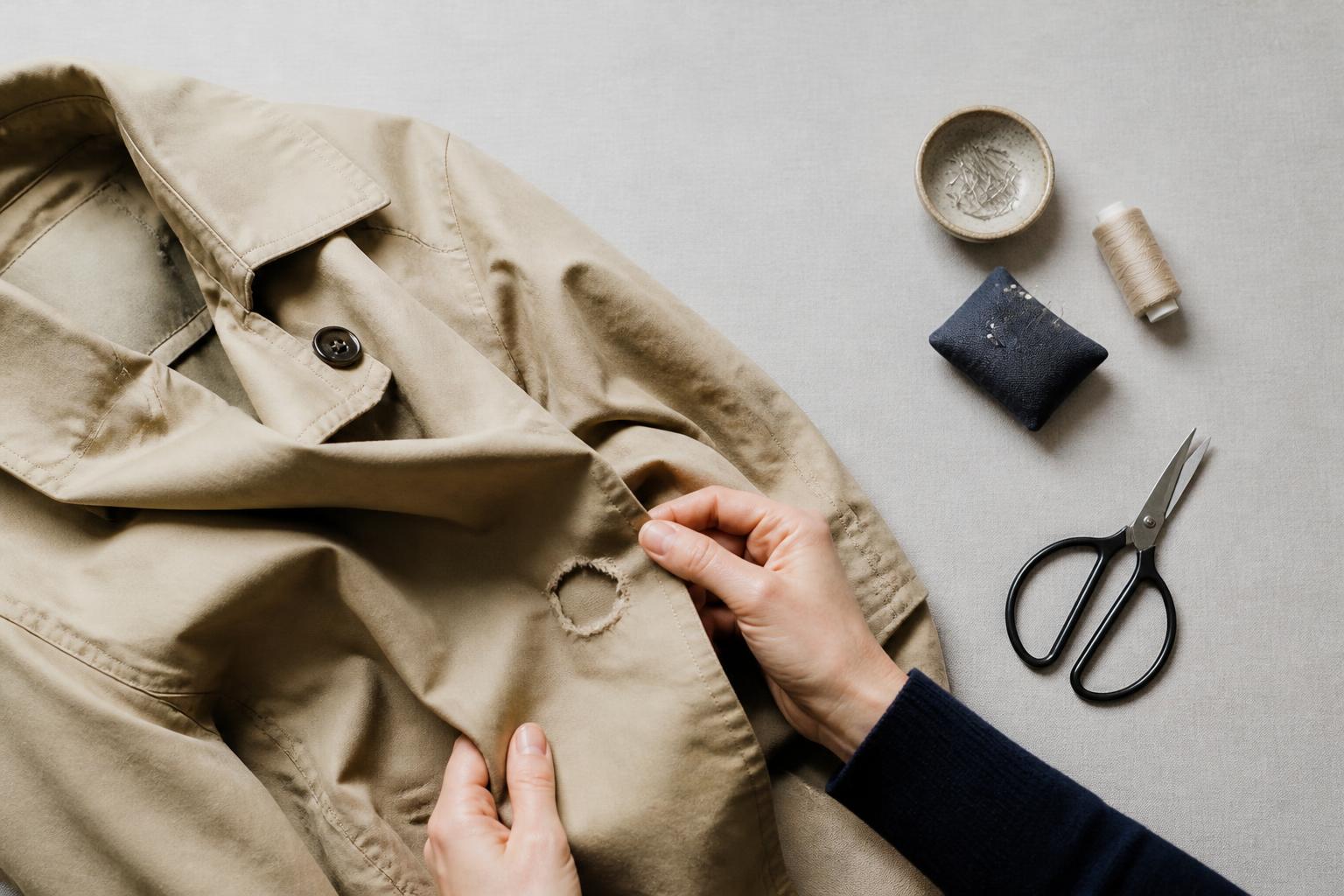
Knit reweaving and invisible mending are specialist jobs. If you have a moth hole in fine wool, a snag in cashmere, or a cigarette burn in a woven coat, this is not one for a general alterations counter unless they specifically offer that service. Reweaving aims to disguise damage by rebuilding the structure of the fabric. It can be excellent, but it is skilled, slow work, and not every town has someone who does it.
Patching and darning are more practical than invisible. A patch can be internal or external. Darning rebuilds worn areas with thread, often on socks, knitwear or thinning elbows. These can be strong, sensible repairs, but they are not always hidden. If you are happy with visible mending, say so. It opens up more options, especially for casual clothes.
Relining is a larger job. If a coat or jacket lining is shredded at stress points, a shop may patch local damage, replace sections, or recommend a full relining. Full relining can make sense on a well-cut wool coat or a good vintage jacket. It makes less sense on a cheaply made item where the outer fabric and interfacing are also failing.
Leather, suede and waterproof garments need specialist handling. Leather requires the right machine, needle, thread and experience, because every stitch leaves a permanent hole. Waterproof jackets are another category again. Ordinary stitching can create leak points, and some repairs need seam sealing or compatible patch materials. If you are dealing with a shell jacket, it helps to understand how to patch waterproof clothing without making leaks worse before you book anything in.
What to check before you leave home
Before you contact a shop, gather the details that affect what is possible.
Start with the care label. In the UK, the label should give fibre content and care symbols. That fibre content matters more than people think. A tear in tightly woven cotton behaves differently from one in viscose, polyester satin or a wool blend. Stretch garments are another separate case, because the repair has to move with the fabric. If the label mentions polyamide and you are not sure what that means in practice, our guide to polyamide and nylon on clothing labels will help you understand the fabric before asking for a repair.
Next, check the garment construction. Is it lined? Does it have shoulder pads, bonded layers, taped seams, topstitching, rivets, cuffs, vents or decorative trim? A straightforward-looking problem can become more involved if the damaged area is trapped between layers or close to hardware.
Take clear photos in good light. Send one full view of the garment, one close-up of the damage, and one slightly wider shot showing where the damage sits. A hem fray at the bottom of wide-leg trousers is one thing. A tear across the knee or seat is another, because the stress and visibility are different.
Be clear about urgency. “As soon as possible” does not mean much. Say whether you need it for work next week, a wedding on Saturday, or a trip next month. Some shops can fit in a quick seam repair but not a zip replacement in the same timeframe.
Look for manufacturer warnings. Outdoor brands may specify that repairs can affect waterproof performance or guarantees. Coated fabrics, heat-bonded seams, faux leather, and laminated materials can all have limits. If the item is washable only at low temperatures, dry clean only, or not suitable for tumble drying, ask whether the repair changes any of that.
Finally, be honest about the item’s overall condition. If the elbows are shiny, the cuffs are frayed and the pocket corners are going as well, one visible fault may not be the whole story. A good repairer will spot that anyway, but it helps if you do too.
How to compare local repair shops without guessing
Once you have the basics, you can compare nearby shops on useful criteria rather than hoping for the best.
First, ask whether they regularly repair your garment type. “Can you replace a zip?” is too broad. “Do you replace two-way zips in padded winter coats?” or “Do you repair fine merino knitwear?” will tell you more. Experience with the exact category matters.
Second, ask for examples of the kind of finish they offer. Some repairs are intended to be strong and tidy, not invisible. Others are sold specifically as discreet or near-invisible. Those are not the same promise. If a shop has photos, look closely at topstitching lines, symmetry, colour matching and whether bulky areas have been handled neatly.
Third, look at how they quote. A useful quote should tell you what they plan to do, not just give a number. For example, “replace full zip with similar moulded zip, restitch original seam line where possible” is better than “zip repair”. If they have not seen the garment in person, expect the quote to be provisional.
Turnaround matters too. Ask for a realistic collection date, not an optimistic one. Small independent shops often have heavy workloads before weddings, graduations, Christmas and holiday seasons. If you need the item by a fixed date, get that written on the ticket or receipt.
Pay attention to the limits they are willing to state. This is often the clearest sign of competence. A good repairer will tell you if a mend will show, if an exact zip match is unlikely, if waterproofing may be reduced, or if worn fabric may fail again nearby. Vague reassurance is less useful than a clear boundary.
It is also sensible to ask whether work is done in-house. Some local counters send specialist jobs elsewhere. That is not automatically a problem, but you should know who is doing the work and whether that affects timescales.
If you are considering a patch repair rather than stitching alone, it helps to know what makes a patch durable. Our guide to choosing clothing repair patches that actually last covers the practical differences between patch types and adhesives.
Questions to ask so the finished repair is usable
A repair can be technically sound and still disappoint if it changes how the garment works. A few questions up front can prevent that.
Ask whether the thread will be matched for colour, weight and stretch. On denim or workwear, contrast topstitching may be part of the look. On fine trousers or a dress, a close colour match matters more.
If a zip is being replaced, ask whether the new zip will match the original in length, tooth size, colour and function. Does it need to be open-ended, concealed, metal, moulded plastic, or a two-way zip? If the exact puller style cannot be matched, is that likely to matter visually or practically?
Ask whether the area will be reinforced. This is especially important for underarms, crotch seams, pocket corners and bagged-out knees, where repeated stress caused the problem in the first place. Reinforcement can extend the life of the garment, but it may add bulk.
Be direct about visibility. Will the repair be nearly invisible from normal distance, clearly visible up close, or obviously a mend? There is no wrong answer, but you want the answer before paying.
Check washing and aftercare. Can the item still be machine washed at the same temperature? Does it need gentler handling? If glue, repair tape or a bonded patch is involved, are there heat limits? This matters particularly with outdoor kit and synthetic fabrics.
Ask whether the repair will affect fit or movement. Taking up a hem on a lined skirt is one thing. Repairing damage across a shoulder, knee or seat can change drape or ease if done heavily.
For technical outerwear, ask specifically about waterproofing, breathability and seam sealing. In the UK we often use “waterproof” loosely, but there is a real difference between a shower-resistant finish and a jacket with taped seams and a membrane. A stitched repair may be acceptable for casual use but not for sustained wet weather. If you are replacing outdoor pieces and want to buy better next time, our guide to choosing waterproof clothing that lasts may help you avoid the same failure point.
When repair is sensible and when it is not
Repair is sensible when the garment is hard to replace, fits unusually well, has sentimental value, or is still sound apart from one local fault. A good wool coat, properly lined trousers, a dress you wear often, or a vintage jacket with better fabric than many new ones can all justify careful work.
It is also sensible when the damage is contained. One failed zip in an otherwise good coat is a classic example. So is a dropped hem, a split seam, or a small hole that can be stabilised before it spreads.
Think about replacement difficulty, not just replacement price. If you can buy a similar black T-shirt anywhere, a fiddly repair may not be worth it. If the item is a well-cut petite coat, a discontinued pair of work trousers that fit properly, or a second-hand find in excellent cloth, the calculation changes.
Cost-per-wear is a useful test. If a repair gets another year or two from something you use weekly, that is often good value even when the repair itself is not cheap. If you are repairing an occasional item you do not actually enjoy wearing, the maths is less convincing.
There are also times to stop. If wear is appearing at multiple stress points, the fabric may be at the end of its life. If the item has hygiene issues that cannot be solved, such as ingrained odour, mildew damage or contamination, repair may not be sensible. Underwear, heavily degraded stretch fabrics, and faux leather that is peeling across large areas are common examples where repair is limited or short-lived.
Repeated stress points deserve special caution. If jeans have already been repaired at the inner thigh twice and the surrounding denim is thinning, another patch may only move the problem a centimetre to the side. If a lining has shredded in several places, a small patch is unlikely to be the end of it.
The best local repair shops will tell you this honestly. That honesty is worth travelling for. A shop that can say “yes, this is repairable, here is how it will look, here is what it will cost, and here is what it will not fix” is far more useful than one that promises vaguely and leaves you guessing.
When you search for clothing repair shops near you, the aim is not simply to find someone with a sewing machine. It is to find someone who can match the repair to the garment, explain the trade-offs clearly, and give you something wearable at the end. If you do a little checking before you go, you are much more likely to come home with a repair that earns its place back in your wardrobe.

Questions about this article or a correction to suggest? Get in touch. Read more about our editorial approach.