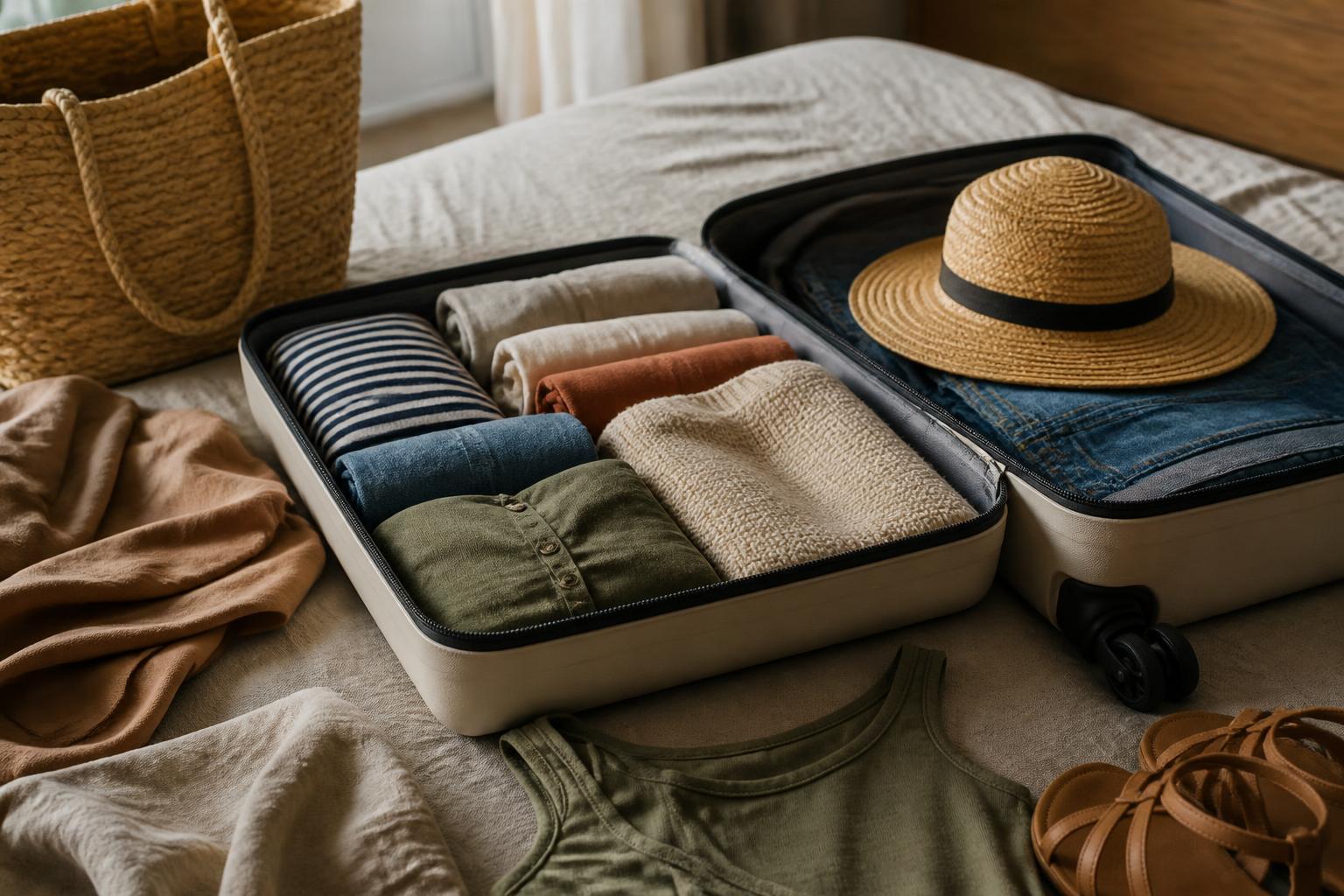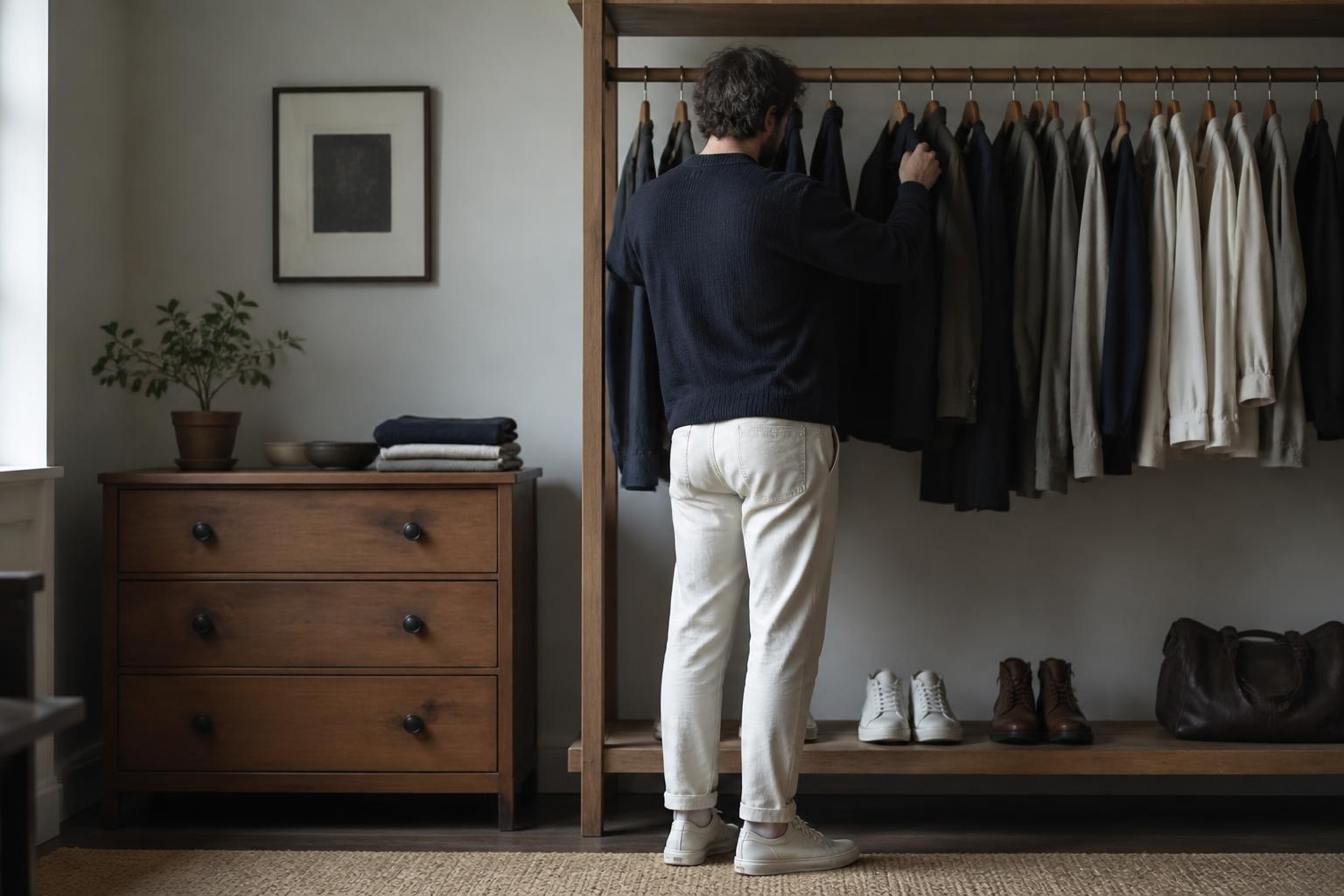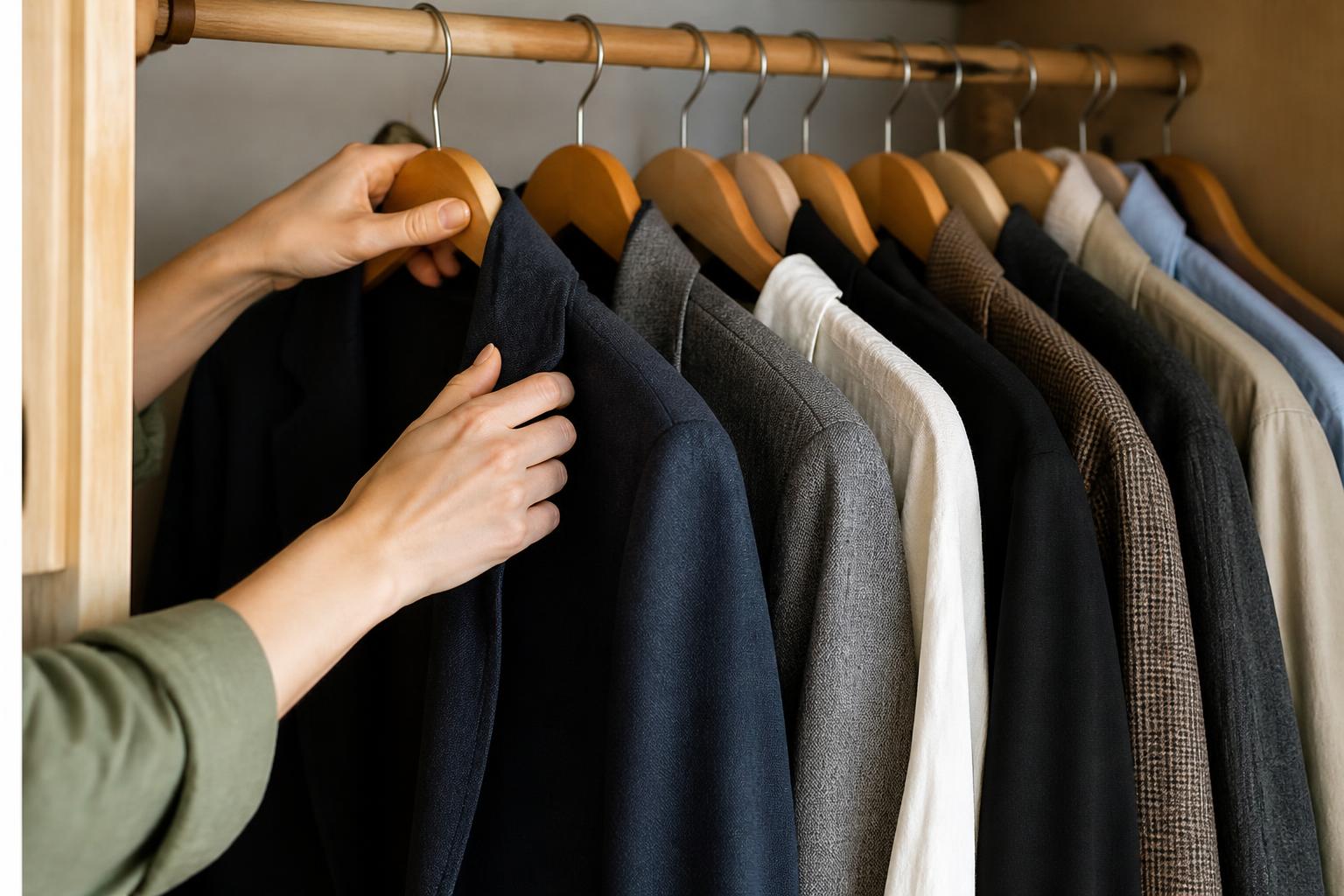
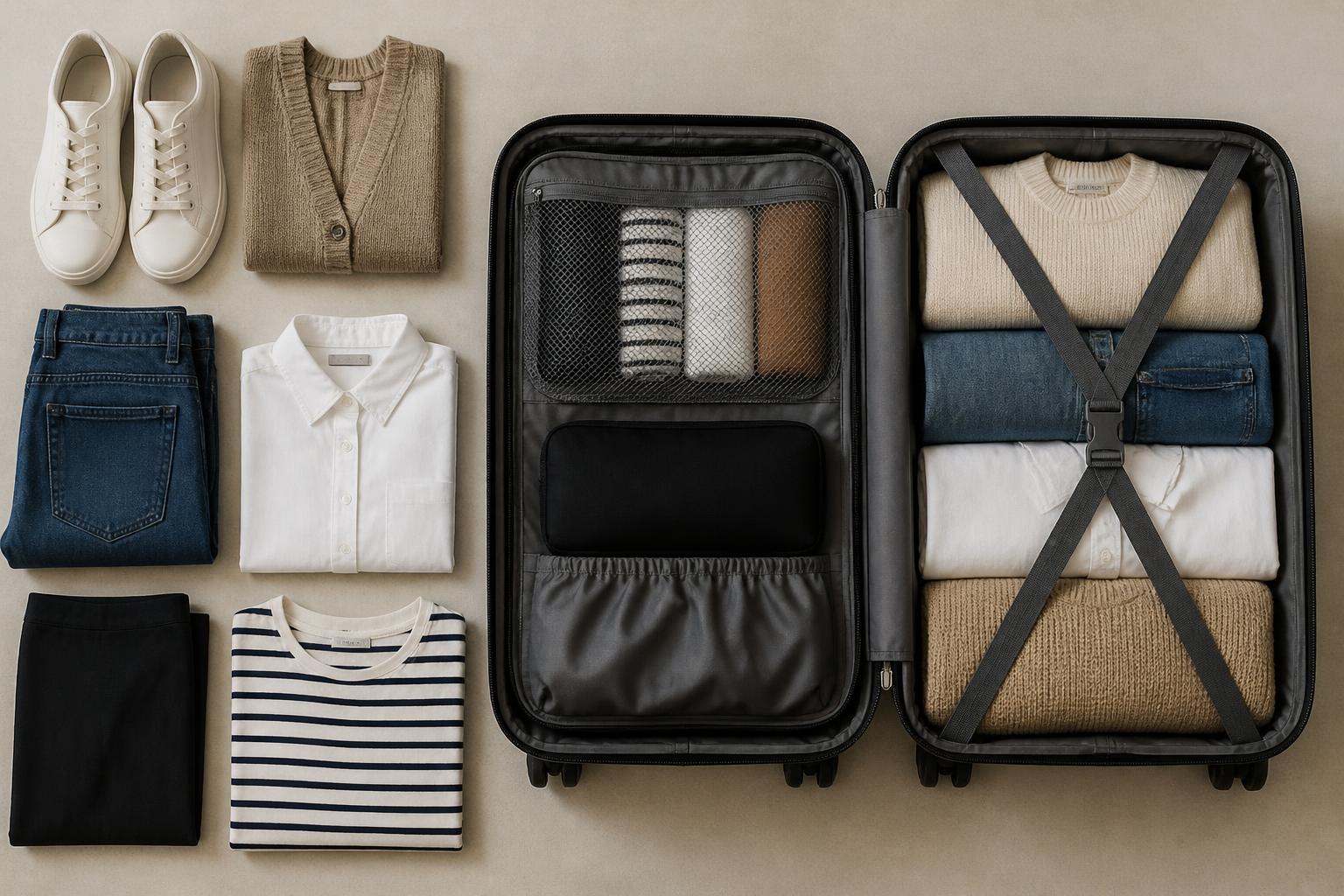
A travel capsule wardrobe is simply a small set of clothes that all earn their place. It fits in hand luggage, covers the weather and plans you actually have, and keeps getting worn in different combinations. The point is not to look as though you packed nothing. The point is to stop carrying items that never leave the case, crease badly, rub your feet to bits, or need care you cannot realistically give them while you are away.
For most trips, the best capsule is built from clothes you already know. Pieces that fit properly, wash without drama, and work with at least two other things in the bag will nearly always beat a “holiday wardrobe” bought in a rush. If you already use a small everyday wardrobe at home, our guide to building a basic capsule wardrobe without buying loads is the same principle, just applied more tightly.
What a travel capsule wardrobe is actually for
A travel capsule wardrobe is for reducing decisions, bulk and risk. It gives you enough to get dressed for the trip you are taking, without packing for every possible version of it.
That matters most when you are travelling with hand luggage only, changing hotels, using public transport, dealing with mixed weather, or trying to avoid checked baggage fees. It also helps when you know you will be carrying your case up stairs, across stations, or over uneven pavements. A lighter bag is not just tidy. It is easier on your back, easier to keep track of, and less likely to turn into a pile of “just in case” extras.
A small travel wardrobe is usually more useful than a full suitcase when your days are varied but not wildly formal. City breaks, work trips with one or two smarter moments, visiting family, train holidays, and week long summer trips are all good examples. If you can repeat outfits without anyone caring, and most people will not, a smaller wardrobe works well.
There are, of course, trips where a strict capsule is less helpful. A wedding weekend with specific dress codes, a walking holiday needing specialist kit, or a trip with large temperature swings may need more category-specific items. Even then, the principle still helps. You do not need a minimalist fantasy. You need a realistic packing list with fewer weak links.
How to plan your capsule around the trip you are taking
Start with the trip, not the clothes. Before you pull anything from the wardrobe, list five practical factors.
First, destination and forecast. Look at daytime temperatures, evening temperatures, wind, rain risk and indoor conditions. A hot city with aggressive air conditioning needs different layers from a hot beach holiday. In the UK and much of Europe, forecasts are useful but changeable, so build in one weather buffer. In winter, that may be a proper knit or a packable waterproof. In summer, it may be a light layer and shoes that can cope with a shower.
Second, activities. Write down what you will actually do on each day. Train travel, museum visits, long walks, dinners out, a meeting, swimming, or one smart event all affect what counts as enough. If the itinerary says “walk all day”, shoes become more important than having another top.
Third, dress codes. “Smart casual” means very different things depending on where you are going. A restaurant that expects a collared shirt or closed shoes changes the plan. So does a workplace where denim is fine, or not fine. If you are travelling for work, it helps to base the trip on the clothes that already serve you in ordinary office life. Our piece on building an office wardrobe that works all week can help if that side of your wardrobe is still a bit patchy.
Fourth, access to washing. This is where many packing lists go wrong. “I’ll wash things there” is only useful if you know how. Will you have a washing machine, a sink, a drying rack, heated towel rail, balcony, or hotel laundry service? In the UK, many accommodation listings say “laundry facilities” when they mean a shared machine or a paid service, so check the details. If you are relying on sink washing, test one or two garments at home first. Some fabrics hold water for ages and simply will not dry overnight.
Fifth, your tolerance for repetition. There is no prize for pretending you enjoy wearing something different every day on a four day city break. If repeating a pair of trousers and changing the top makes life easier, that is the sensible plan.
Once you have those five points, sort your list into categories rather than outfits. Think in terms of tops, bottoms, layers, shoes, underwear, sleepwear and activity-specific items. That makes it much easier to see duplication.
The easiest formula for choosing clothes that will all work together
The simplest working formula is this: choose one base colour, one secondary neutral, and one or two accent colours. Then make sure every top works with every bottom, and every shoe works with most of the bag.
For many people, the easiest base colours are navy, black, olive, grey, denim or stone. Your secondary neutral might be white, cream, brown or another shade that already appears in your wardrobe. Accent colours can come through tops, scarves, knitwear or one dress or shirt that lifts the whole set.
The practical test is better than the style test. Lay everything on the bed and ask:
- Can each top be worn with at least two bottoms?
- Can each bottom be worn with at least three tops?
- Does the outer layer work over all the tops?
- Can you wear the same shoes with more than one kind of outfit?
- Are you packing anything only because it “might be nice”?
A very workable structure is:
- 3 to 5 tops
- 2 to 3 bottoms
- 1 mid layer
- 1 outer layer, if needed
- 2 pairs of shoes at most
- 1 smarter item or one activity-specific item, if the trip requires it
That is enough variation for most hand-luggage trips without making the bag feel joyless. You can still have personality. Pattern, texture and accessories do a lot of work, especially when the main colours are steady.
This is also where bag choice matters. A flimsy tote that cuts into your shoulder or a crossbody that holds nothing useful can make a neat capsule much less practical. If you are choosing one travel bag to use with most outfits, our guide to bags that work harder in your wardrobe covers the features worth checking.
How many pieces do you really need?
There is no single correct number, because trip type, weather and laundry access change everything. But examples are useful, especially if you tend to overpack.
For a 2 to 3 night city break, many people can manage with:
- 2 bottoms, or 1 bottom plus 1 dress
- 3 tops
- 1 knit or overshirt
- 1 coat or waterproof if needed
- 2 pairs of shoes, one worn in transit
- underwear and socks for each day, plus one spare
- sleepwear
- any specific item such as swimwear, gym kit or one smarter top
For a 5 to 7 day trip with no washing, a realistic hand-luggage capsule might be:
- 3 bottoms, or 2 bottoms plus 1 dress
- 4 or 5 tops
- 1 mid layer
- 1 outer layer
- 2 pairs of shoes
- 7 sets of underwear, or fewer if you know you can wash and dry them
- sleepwear
- one small accessory set, such as scarf, belt or jewellery, if you use them
For 10 days or more, the answer is usually not “pack for 10 days”. It is “pack for 5 to 7 days and wash”. That might mean:
- 3 bottoms
- 5 tops
- 1 or 2 layers
- 2 pairs of shoes
- enough underwear for 5 to 7 days
- a small laundry plan, not just a hopeful thought
These are examples, not rules. If you wear dresses most days, your mix will look different. If you are travelling somewhere hot, tops may increase while layers shrink. If you are going somewhere cold, bulkier knitwear may reduce the total piece count because hand luggage fills quickly.
One useful check is volume rather than numbers. Two heavy jumpers can take more space than four light tops. One pair of chunky boots can displace half a bag. Count pieces, yes, but also look at what the case can actually hold once toiletries, chargers and documents are in.
Care labels, fabrics and laundry choices that matter when you travel
Fabric and care instructions make or break a travel capsule. A beautiful top that says “dry clean only” may be fine for one evening, but it is a poor choice if there is any chance of spills, sweat or rain and no easy cleaning option.
Read the care label before you pack, not after something goes wrong. In the UK, garments sold here must carry fibre composition and care information, but the symbols are guidance rather than a promise that every home wash method will suit every item. If a label says hand wash, ask yourself whether you are honestly willing to do that in a hotel sink. If it says reshape while damp, dry flat, or do not tumble dry, think about whether your accommodation gives you the space and time.
In general, useful travel fabrics share a few qualities:
- they dry reasonably quickly
- they do not crease beyond rescue
- they cope with repeat wear
- they are comfortable in shifting temperatures
- they can be cleaned without fuss
That does not mean everything must be synthetic. In fact, many cheap synthetics trap odour and can be miserable in heat. Cotton can work very well, especially lighter weaves, but some cottons dry slowly. Linen is airy and pleasant in hot weather, but it creases, so only pack it if you are happy with that look. Merino wool is excellent for repeat wear and temperature regulation, though it needs gentler care and is usually pricier. Blends are often practical because they balance softness, durability and drying time.
If you want a clearer sense of what different fibres are like in ordinary use, our guide to clothing fabrics that last in real wardrobes covers the trade-offs.
Repairability matters too. A loose button, dropped hem or split seam is easier to deal with than a peeling print or bonded trim coming away. For longer trips, we often pack a tiny repair kit, just a needle, a few metres of thread, and a spare button if a garment came with one. It weighs almost nothing and can save a favourite shirt.
Laundry choices are worth deciding in advance. Hotel laundry is convenient but can be expensive, and turnaround times vary. Launderettes are straightforward if you have enough to justify a load. Sink washing works best for underwear, socks, lightweight tops and sportswear, but only if you can wring them gently in a towel and hang them somewhere with airflow. Thick jersey, denim and heavy cotton are poor candidates for overnight drying.
How to avoid common packing mistakes that make a capsule fail
The first mistake is packing for fantasy versions of yourself. If you never wear a blazer at home, a trip is unlikely to change that unless the dress code truly requires it. If you do not enjoy white trainers for long walks, a holiday is not the time to break them in.
The second is too many single-use items. A skirt that only works with one top, a shirt that needs one specific bra, or shoes that only suit one dinner outfit all take up space without helping the rest of the bag. In a good capsule, most things have at least two jobs.
The third is uncomfortable shoes. This is the failure point we see most often. People will tolerate repeating clothes. They will not enjoy hobbling through a city because they packed shoes for appearance rather than miles. Wear your bulkiest, most reliable pair in transit, and pack only one alternative unless the trip genuinely needs more.
The fourth is a weather gap. This often happens in shoulder seasons, when travellers pack for the nicest forecast and ignore the cold evening, the windy ferry crossing, or the wet journey to the station. One proper layer is usually more useful than an extra outfit.
The fifth is overestimating laundry. Do not assume you will happily wash clothes every night. You may come back late, find nowhere to hang them, or discover the room is too damp for anything to dry. Build a capsule that works even if you skip one wash cycle.
The sixth is taking too many “backup” toiletries and accessories, which steals space from clothes that actually earn it. Decant what you can, check airline liquid limits if you are flying with hand luggage in the UK, and remember that most forgotten basics can be bought more easily than an extra pair of feet can be packed.
Finally, do not let the idea of a travel capsule wardrobe turn into another perfection project. The aim is not to own the ideal set of matching garments in some imaginary neutral palette. The aim is to use what you have, see where the gaps really are, and make future trips easier. After one or two journeys, patterns appear. You will notice which fabrics dried quickly, which shoes were worth the space, and which “just in case” pieces never left the bag. That is the useful information. Build from that, and hand-luggage travel gets much simpler.

Questions about this article or a correction to suggest? Get in touch. Read more about our editorial approach.