A small hole in a T-shirt is usually repairable at home if you catch it early. For a pinhole or short split in jersey fabric, the neatest fix is often a few careful hand stitches that bring the edges together without pulling the fabric tight. If the area looks thin, stretched or likely to tear again, adding light support on the inside will usually last better than stitching alone.
The key is to stop the damage spreading before the next wash or wear. Check what caused the hole, choose a repair that suits stretchy fabric, and work gently. T-shirt jersey shows puckering quite easily, so a tidy repair is less about sewing fast and more about using the right needle, thread and tension.
Start by checking why the hole appeared
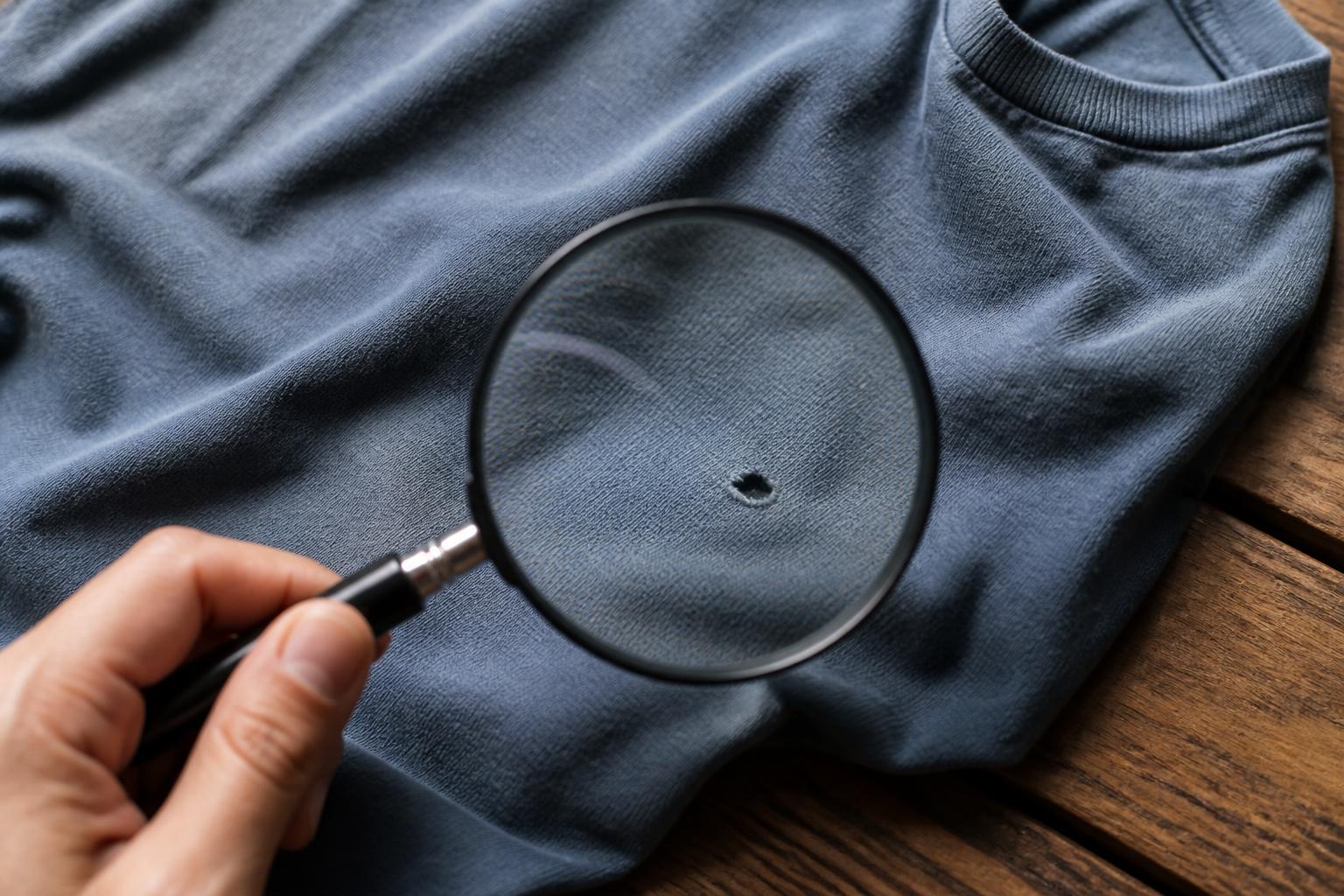
Before you thread a needle, look closely at the damage in good light. A repair only holds well if the surrounding fabric is still sound.
Start with three checks.
First, look at the shape of the hole. A clean little slit or pinhole often comes from catching the fabric on something sharp, such as a zip, belt buckle, drawer handle or rough edge on a worktop. A ragged hole with fuzzy edges can mean the fabric has worn thin first and then given way.
Second, stretch the area gently between your fingers. If the knit around the hole looks stable and springs back, a simple hand repair may be enough. If it goes wavy, looks shiny with wear, or you can see the knit thinning beyond the hole itself, you will usually get a better result with support on the inside.
Third, think about placement. Tiny holes near the lower front of T-shirts are often caused by repeated rubbing against jean buttons, trouser fastenings or kitchen counters. Holes near seams can point to strain or poor construction. Holes at the shoulder may come from bag straps. If you do not deal with the cause, even a careful mend can fail quickly.
It is also worth checking the care label before you do anything involving heat. Most cotton jersey is straightforward, but T-shirts with elastane, modal, prints or heat-applied trims may need gentler handling. If you are deciding whether the fabric itself is likely to wear well over time, our guide to modal or cotton for everyday clothes helps with the trade-offs.
A simple repair will usually hold if all of these are true:
- the hole is small
- the surrounding fabric still feels strong
- the area is not under heavy strain
- the repair does not need to be invisible from very close up
If one or more of those is not true, skip ahead to reinforcement or consider whether home repair is the right option.
What you need for a small T-shirt repair
You do not need a full sewing kit to mend one small hole. A few basic items are enough, and they are useful across lots of everyday repairs.
For most cotton and stretchy T-shirts, we use:
- a fine hand sewing needle, often labelled sharps, in a small to medium size
- polyester sewing thread in a close colour match
- small sharp scissors or thread snips
- pins or sewing clips
- a smooth surface with good light
- an iron, if you plan to use fusible support
- a pressing cloth, such as a clean cotton tea towel or pillowcase
If the T-shirt is very fine, a finer needle matters. A thick needle can leave more visible holes in jersey than the original damage. Polyester thread is usually more practical than cotton thread for T-shirts because it has a little give and copes better with movement in knit fabric.
Useful extras, not essential but handy:
- a needle threader
- a magnifying lamp or strong reading glasses for very small holes
- lightweight fusible interfacing or knit repair backing
- a jersey or ballpoint machine needle if you decide to use a sewing machine for another repair nearby
Try not to overbuy. For one or two occasional mends, one spool of good all-purpose thread, one pack of fine hand needles and a small piece of lightweight support fabric will cover a lot of ground.
If you are considering patches or iron-on products, choose carefully. Thick, stiff patches can make a T-shirt uncomfortable and obvious. Our guide to clothing repair patches that actually last explains what to look for.
How to sew up a tiny hole by hand
For a very small hole in stable jersey, hand sewing is often the cleanest answer. The aim is not to drag the fabric shut like a drawstring. It is to nudge the broken edges back together so the knit sits as naturally as possible.
Here is the method we use.
First, wash and dry the T-shirt only if it is dirty and the care label allows it. If the fabric is clean already, mend first. A dirty repair area can be harder to handle, but repeated washing before repair can enlarge the hole.
Lay the T-shirt flat on a table. Smooth the fabric so it sits in its natural shape, not stretched. If the area is curling, you can lightly press it first, following the care label and using a pressing cloth.
Thread a fine needle with a short length of thread, around 30 to 40cm is usually enough. Too much thread tangles and rubs the fabric. Knot one end with a small knot.
Turn the T-shirt inside out if the hole is easy to access from the back. Starting from the inside helps hide the knot. Bring the needle up close to the edge of the hole, not far away in healthy fabric.
Now take tiny stitches across the hole, catching just a few threads of the knit on each side. Think of it as bridging the gap bit by bit. Keep the stitches close together and shallow. On jersey, large stitches can show and distort.
After every few stitches, pause and check the right side. The edges should meet, not overlap. If you pull too tightly, the fabric will pucker. If that happens, unpick those stitches and start again with less tension. This is the part that matters most when people ask how to repair a small hole in a T-shirt neatly. Tight stitches make the mend more obvious than the hole did.
For a pinhole, you may only need a small circle of tiny stitches around and across the opening. For a short slit, work along the length of the split with very small oversewing or ladder-style stitches. The exact stitch matters less than control and light tension.
When the hole is closed, secure the thread on the inside with two or three tiny backstitches in sound fabric close to the repair. Trim the thread ends neatly.
Then turn the T-shirt right side out and inspect it. If the fabric looks slightly raised, place a pressing cloth over the area and give it a very light press, if the care label permits. Do not drag the iron. Just press and lift. This helps the stitches settle into the knit.
A few practical points help a lot:
- Match the thread colour to the fabric, not the print or trim.
- Work in bright light so you can catch the knit threads cleanly.
- Do not mend while holding the fabric in the air. A flat surface keeps tension even.
- Avoid chunky knots.
- If the hole sits in very stretchy fabric, support may work better than stitching alone.
If you are tempted to use fabric glue, be cautious. Many glues dry stiff, mark the fabric, or fail in the wash. For soft jersey, careful stitching or lightweight support is usually better.
When a patch or fusible support works better
Sometimes closing the hole is not enough. If the fabric around it is thinning, if the hole sits in a high-friction area, or if the jersey is very soft and drapey, reinforcement from the inside often gives a stronger and flatter result.
The best option for a T-shirt is usually not a thick visible patch. It is a lightweight support piece on the inside, just big enough to stabilise the area without creating a hard square.
This works well when:
- the hole has started to ladder or widen
- the surrounding fabric looks worn
- there are several tiny holes close together
- the area rubs against buttons, belts or work surfaces
- hand stitches alone would distort the knit
A lightweight fusible interfacing designed for garments can work, provided the care label allows ironing and the fabric can tolerate the heat. Cut a small rounded piece, larger than the damaged area by at least several millimetres all round. Rounded corners are less likely to lift than sharp ones.
Place the support on the inside of the T-shirt, adhesive side to the fabric if it is fusible. Use a pressing cloth and apply heat exactly as the product instructions say, adjusting only within what the garment care label allows. In the UK, care labels generally follow internationally recognised symbols, but the practical point is the same here as elsewhere, always stay within the garment's own limits rather than relying on generic advice.
Once the support is attached, you may find the hole is stable enough to leave alone if it has closed back into the knit and is not conspicuous. More often, you will still want to add a few tiny hand stitches on the right side or from the inside to bring the edges together neatly.
If you do not want to use heat, a small sew-in patch of very lightweight jersey or knit repair fabric can be attached from the inside with tiny stitches around the edge. Keep it soft and thin. Old T-shirt fabric can work if it is smooth and similar in weight.
This is also the point where product choice matters. Some iron-on patches sold for general clothing are too heavy for T-shirts. If you want a better sense of what holds up and what turns stiff, our piece on wardrobe care that helps clothes last longer is useful alongside choosing repair materials.
How to wash and wear the T-shirt after mending
A fresh repair is usually at its weakest after the first wash or two, so treat it gently. Follow the care label, but keep handling as light as you can.
If the label allows machine washing, turn the T-shirt inside out. Washing inside out reduces abrasion on the repaired spot, especially if it is on the front. Use a normal detergent and avoid overloading the drum, which increases rubbing. A mesh laundry bag is useful for very lightweight or favourite T-shirts.
Choose a lower temperature if that suits the garment and how soiled it is. There is no need to wash hotter than the care label allows, and extra heat will not improve a repair. If the T-shirt has a fused support on the inside, cooler washing and gentler spinning can help it last.
Air drying is kinder than tumble drying for most mended jersey. If the care label allows tumble drying and you need to use it, choose a lower setting where possible. High heat and tumbling can stress both stitches and adhesive supports.
When wearing the T-shirt again, pay attention to the original cause. If the hole was near the hemline at the front, check for friction from jean buttons, metal hardware, aprons, seatbelts or kitchen counters. If a bag strap caused the damage, rotating bags or adjusting the strap can help.
It is also worth storing repaired T-shirts so they are not snagged by zips or rough trims. If your storage is cramped, our guide to seasonal wardrobe storage that works in a small home has practical ways to reduce that kind of wear.
After the first couple of washes, inspect the mend again. If the stitches are holding and the fabric around them still looks sound, the repair has probably settled in well. If new strain lines appear, add support sooner rather than waiting for a larger tear.
When not to repair it yourself
Home repair is worthwhile, but not every T-shirt hole is a good candidate for a simple hand mend.
We would think twice about repairing it ourselves if the fabric around the hole feels thin across a wider area. You can close one opening, but if the knit has started to fail generally, another hole may appear next to the first. This is common in older, very lightweight cottons and some blends that have simply reached the end of their useful life.
Be cautious too if the hole sits on a very visible part of the garment, such as the centre chest on a plain fitted T-shirt, and you want a near-invisible finish. Small hand repairs can be neat, but on smooth plain jersey they are rarely completely undetectable at close range.
Seam damage is another category. If the hole is actually a seam pulling apart, the fix is different. You may need to restitch the seam with the right stretch, and if the seam allowance has frayed away there may not be enough fabric left for a durable repair.
Printed T-shirts can also be awkward. If the hole runs through a print, iron-on support may affect the surface, and visible stitching can interrupt the design. Delicate fabrics, burnout jerseys and very stretchy rib knits can be similarly fiddly.
Do not repair it yourself if the care label rules out the method you need and there is no safe alternative. For example, if a support product requires heat that the fabric cannot take, forcing it is likely to leave a shiny mark or distortion.
Finally, be realistic about value. If a low-cost T-shirt has multiple holes, thinning fabric and stretched seams, your time may be better spent salvaging it for cleaning cloths or patch material than trying to rescue it as a reliable wardrobe staple.
A small hole does not have to mean the end of a T-shirt. If the fabric is still sound, a careful hand mend or a bit of lightweight support can stop the damage spreading and keep the top in use for much longer. The trick is to repair early, work gently, and match the method to the condition of the fabric rather than forcing one fix on every hole.

Questions about this article or a correction to suggest? Get in touch. Read more about our editorial approach.