
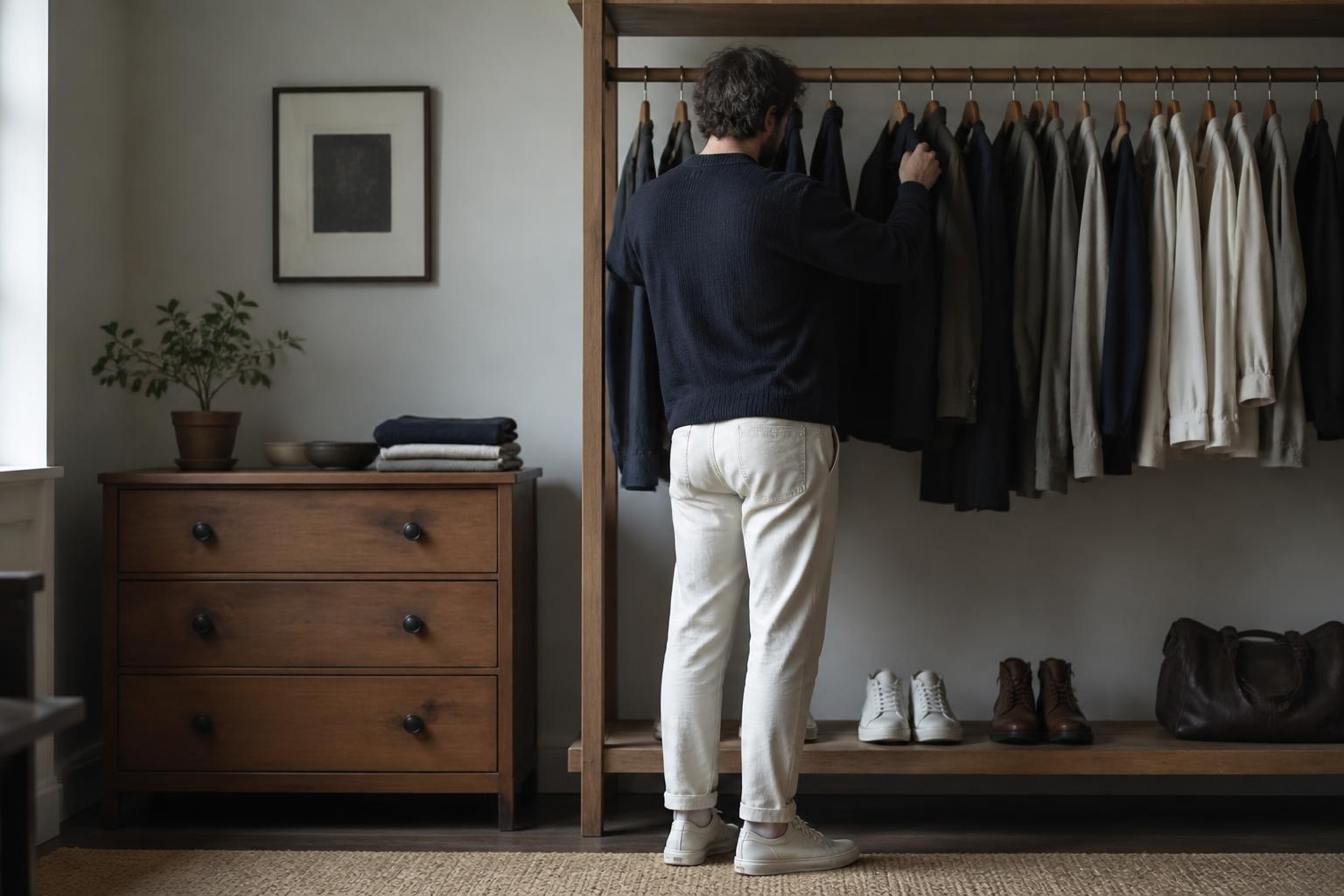
A men’s capsule wardrobe is not a strict uniform, and it is not a challenge to own as little as possible. In real life, it is a smaller set of clothes that you actually wear, that work together, and that suit your week, your budget and the British weather. The point is not to have fewer things for the sake of it. The point is to stop wasting money and space on clothes that do not fit, do not layer well, need awkward care, or only work with one other item.
Done properly, a capsule wardrobe cuts clutter without cutting options. You still need enough for work, weekends, washing delays and temperature changes. What changes is that each piece earns its place. Instead of a rail full of near misses, you end up with clothes that get worn, washed, repaired and reworn.
What a capsule wardrobe means in real life
A capsule wardrobe for men usually means a compact wardrobe built around repeat wear and easy combinations. In UK terms, that often includes layers for damp mornings, shoes that can handle pavements and public transport, and clothes that move between heated offices, home working, pubs, family visits and ordinary weekends.
That matters because most wardrobe problems are not really about quantity. They are about friction. You open the wardrobe and half of it is wrong for the day. Shirts need ironing. Trousers only work with one pair of shoes. Knitwear is hand wash only, so it sits unworn. A jacket looked smart in the shop but does not fit over a jumper. You own plenty, but getting dressed still feels like a rummage.
A practical men capsule wardrobe solves that by narrowing your wardrobe to useful categories and reliable combinations. It does not require a fixed number of items, and it does not assume every man needs the same list. A solicitor in a city office, a teacher, a tradesman on estimates, and someone working from home will all need different versions.
It also does not need to be built from scratch. In most cases, the best starting point is what you already own and already reach for. If you want a simpler way into that process, our guide to building a basic capsule wardrobe without buying loads sets out how to reduce decision fatigue without turning your wardrobe into a minimalist performance.
Audit what you already own before you buy anything
Before you buy a single replacement, pull out everything you currently wear, or think you wear, and sort it properly. Bed, floor, clean table, any flat surface will do. The aim is to see your actual wardrobe, not the version in your head.
Start with four piles.
- Worn often
- Worn sometimes
- Rarely or never worn
- Out of action, because of fit, damage, missing buttons, stains or care hassle
Now check each item against four things.
Fit
Does it fit now, with the underwear and layers you actually wear? Not whether it might fit if you lose half a stone, and not whether it technically fastens. Try on the awkward ones. Look at shoulder seams, seat, rise, sleeve length and whether you can move in them.
Condition
Check collars, cuffs, hems, crotch wear, underarms, knees, pocket corners, sole wear and zip function. Good light helps. A T-shirt can look fine on a hanger and be twisted, thinned or yellowed under the arms when you inspect it properly.
Wear frequency
Be honest. If you have not worn something through an entire season, ask why. The answer is usually useful. It may be uncomfortable, too formal, hard to wash, the wrong colour, or simply beaten by better alternatives.
Care labels
This is where many overbought wardrobes reveal themselves. If a jumper says hand wash only, dry flat, reshape while damp, and you know you will not do that often, it is not a practical core piece for you. If a shirt needs careful ironing every wear and you avoid ironing, it will not become a staple by force of optimism.
In the UK, care labels on textile products are expected to provide clear care information, but they are not a guarantee that every item will behave perfectly in your machine. Fibre mix, construction and dye can still affect results. If you are buying or keeping clothes for hard use, practical washability matters as much as style.
As you sort, make simple notes. Not a spreadsheet unless you like one. A phone note is enough. You are looking for patterns such as:
- You wear the same two pairs of trousers constantly
- You own too many “good” shirts and not enough everyday layers
- Most neglected items are dry clean only
- Navy and olive get worn, bright colours do not
- You run out of socks and underwear before anything else
- You avoid half your knitwear because it itches or pills
This is the point where many people realise they do not need “more clothes”. They need fewer awkward ones, and a clearer base.
Choose the core pieces around your actual week
Internet capsule lists tend to be neat, fixed and slightly fictional. Five tees, two shirts, one blazer, one white trainer, and somehow that covers every life. It does not. We get better results by planning from your real week backwards.
Start with four practical questions.
What do you wear for work?
If you work in a formal office five days a week, your core may need more shirts, smarter trousers and a reliable rotation of leather shoes. If you work from home, your core may lean harder on knitwear, overshirts, dark jeans and presentable casual layers for video calls and quick meetings.
What is your laundry routine?
If you wash once a week, you need a deeper bench of basics than someone doing midweek loads. If you use a launderette, hand wash less, or have limited drying space, that affects what is realistic. In many UK homes, winter drying time is a real constraint. A wardrobe full of heavy cotton that takes days to dry can create a bottleneck very quickly.
What is your local weather like?
A capsule for Cornwall, Manchester and London will overlap, but not perfectly. Think about rain, commuting, heated indoor spaces and how often you walk. A lightweight waterproof, a proper mid-layer and shoes with some grip may matter more than another “going out” shirt.
What is the actual dress code?
Not the one you imagine, the one you live with. If your office says smart casual but everyone wears chinos and merino jumpers, you probably do not need three blazers. If your weekends are mostly school runs, shopping and seeing family, buy for that life first.
From there, think in categories, not rigid numbers.
You will usually need:
- Base layers, such as T-shirts, vests if you wear them, underwear and socks
- Everyday tops, such as polos, shirts, OCBDs, rugby tops, knitwear or sweatshirts
- Trousers, such as jeans, chinos, cords or wool trousers depending on lifestyle
- Layers, such as overshirts, cardigans, fleeces or lightweight knits
- Outerwear, such as a waterproof, wool coat, bomber or insulated jacket
- Shoes, often one smarter pair, one everyday pair, and one weather-ready pair
- Occasion pieces, only where your life genuinely requires them
For a lot of men, the weak point is not the headline item. It is the support structure. A good jacket is wasted if you only own one pair of trousers that works with it. Smart shoes gather dust if all your socks are sports socks and your trousers break badly on the shoe.
This is why we advise choosing around combinations. If one pair of dark trousers works with three tops and two pairs of shoes, it is more useful than a more exciting pair that only suits one outfit.
If you are trying to keep things affordable, prioritise what gets the highest wear. That usually means underwear, socks, everyday trousers, knitwear and weatherproof outerwear before niche items. For more grounded examples, our piece on sustainable mens fashion that works for a real UK wardrobe looks at buying less, but buying for repeat use.
How to make fewer clothes work harder together
A smaller wardrobe only works if the pieces combine easily. This is where many attempted capsule wardrobes fail. People reduce numbers, but keep random colours, awkward fabrics and shoes that limit everything else.
Keep the colour palette tight
You do not need to dress in beige and grey unless you want to. You do need colours that cooperate. A practical base for many men is navy, charcoal, olive, ecru, black, brown, white and mid blue denim. From there, add one or two accent colours you genuinely wear, such as burgundy, rust or forest green.
The goal is simple. Most tops should work with most trousers, and most trousers should work with at least two pairs of shoes.
Use layering to stretch the wardrobe
Layering is what makes a UK capsule wardrobe realistic. A T-shirt under an overshirt, a shirt under a lambswool crew neck, a fine knit under a jacket, these combinations let the same pieces work across changing temperatures.
Pay attention to bulk. If your coat only fits over a T-shirt, it is less versatile than it looks. If your overshirt is too slim to wear over anything but a vest, it is really just a shirt.
Choose fabrics with wear and care in mind
Fabric affects comfort, maintenance and lifespan. Cotton is straightforward, but weights vary. Merino is useful for temperature regulation and can often be aired between wears, but some versions are delicate. Lambswool can be hard-wearing but may feel scratchy to some people. Linen blends can be easier than pure linen if you dislike heavy creasing.
Look at the fibre content label and handle the cloth if you can. Also check construction. A thick fabric with poor stitching can still fail quickly. We go into that in more detail in our guide to choosing clothing fabrics that last in real wardrobes.
Coordinate shoes early, not as an afterthought
Shoes can quietly limit a whole wardrobe. If all your trousers are cropped or narrow and your only winter shoes are bulky boots, the proportions may feel off. If all your smart trousers need black shoes and your best everyday belt is brown, you create needless friction.
For many men, three lanes are enough:
- Everyday casual, such as leather trainers, derbies or sturdy loafers
- Wet weather or winter, such as boots with grip and decent uppers
- Smarter occasions, if your life needs them
You do not need every shoe to go with every trouser, but each trouser should have an obvious shoe partner.
Use care labels, repairs and second-hand checks to avoid false economy
The cheapest item is not the one with the lowest ticket price. It is the one that stays in use. A men capsule wardrobe only saves money if the clothes survive regular wear and do not create endless replacement cycles.
Read care labels before buying
A quick label check in the shop can prevent a lot of regret. Look for:
- Washing temperature
- Whether it can be tumble dried
- Ironing limits
- Dry clean only wording
- “Wash separately” or dye-transfer warnings
- “Dry flat” instructions on knitwear
In the UK, as in the EU, care symbols are widely standardised in practice, but brands still vary in how cautious their wording is. If you know you wash most loads at 30°C and air dry, buy clothes that can live with that. If an item requires special treatment every time, make sure it deserves the effort.
Learn the repairs worth doing
Not every repair is sensible, but many are. Worth doing, in most cases:
- Replacing missing buttons
- Restitching hems
- Repairing open seams
- Resoling quality leather shoes
- Replacing a zip on a good jacket or pair of trousers
- Darning small holes in knitwear
- Patching worn elbows or knees on casual pieces
Less often worth doing:
- Cheap shoes with split uppers
- Thin T-shirts gone transparent
- Trousers worn through repeatedly in the same spot if the fit is wrong
- Jackets with failing bonded layers or peeling coatings
A basic sewing kit solves more than people expect. If you do not sew, a local alterations shop can often handle hems, seams and zip replacements more cheaply than replacing the garment with something equivalent in quality.
Store things so they stay wearable
Storage is not glamorous, but it protects what you own. Fold heavy knitwear rather than hanging it. Use shoe trees if you already own leather shoes worth maintaining, but if not, at least dry them away from direct heat and rotate wears. Brush coats and wool jackets occasionally. Empty pockets before hanging trousers. Make sure clothes are clean before long-term storage, especially at the end of winter.
Check second-hand properly
Second-hand shopping is one of the best ways to build a capsule wardrobe affordably, but only if you inspect carefully. Look for:
- Fibre content and care label still attached
- Underarm staining or deodorant build-up
- Crotch thinning in trousers
- Seat shine on wool trousers
- Collar wear
- Pilling, especially under arms and at side seams
- Zip function
- Sole wear and cracking on shoes
- Alterations that may affect fit, such as shortened sleeves or narrowed waists
Ask for measurements, not just tagged size, when buying online. Compare them with a garment you already own and like. UK sizing is not consistent, and older second-hand pieces can differ significantly from current high street fits.
Review the wardrobe after a month of wear
A capsule wardrobe is not finished the day you tidy the rail. It needs a short review after real use. One month is usually enough to show what works and what only looked good in theory.
Keep it simple. For four weeks, notice three things.
What you reached for repeatedly
These are your true core pieces. They fit, they suit your life, and they are easy to wear. Make a note of what they have in common. Maybe you like softer collars, roomier thighs, darker neutrals, machine washable knits or lighter layers than you expected.
What created laundry bottlenecks
If you kept running out of socks, plain tees or work shirts, that is a real gap. If your only decent jumper was always in the wash, that tells you more than any capsule checklist online. Buy to relieve pressure points, not to complete a theoretical set.
What still did not earn its space
If an item stayed unworn even after the clear-out, ask why one last time. If the answer is still vague, it probably does not belong in your working wardrobe. Sell it, donate it, or move it out of the main rotation.
At this stage, we recommend a small reset:
- Remove anything you did not wear
- Repair anything you did wear but nearly sidelined
- Replace one or two genuine basics if needed
- Hold off on “interesting” purchases until the base is stable
That final point matters. Most clutter returns through exception buying. A patterned overshirt, a sale jacket, a pair of shoes that only works with one outfit. None of these are wrong in themselves. They just make more sense once the everyday wardrobe is doing its job.
A good men capsule wardrobe should feel easier after a month, not stricter. You should spend less time deciding, less money replacing mistakes, and less effort dealing with awkward care. You do not need perfection, and you do not need very few clothes. You need a wardrobe that reflects the week you actually live, and pieces that keep proving their worth.

Questions about this article or a correction to suggest? Get in touch. Read more about our editorial approach.