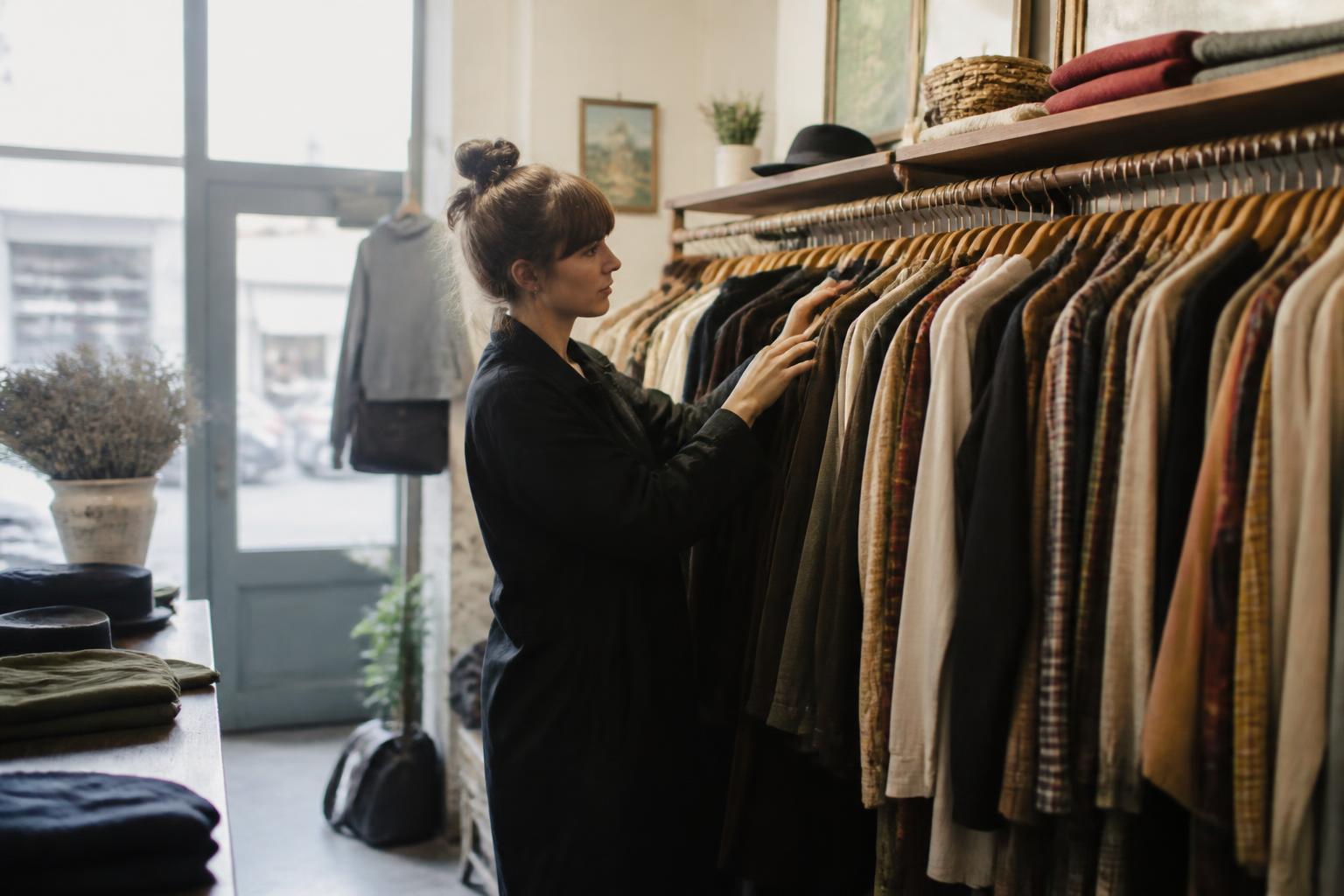
Luxury is easy to fake. Heavy boxes, soft lighting, a famous logo and a high price can all create the feeling that a garment must be better. Sometimes it is better. Often it is simply better marketed.
The useful way to judge a luxury brand is to ignore the theatre and look at what will matter after six months, two years and ten wears too many. We look at fibre content, care requirements, seam allowances, spare buttons, whether a zip can be replaced, whether the brand says anything precise about labour and materials, and whether the piece still makes sense if we strip away the story around it. That matters just as much when we are comparing established labels with newer luxury sustainable fashion brands.
What makes a fashion brand feel luxury, and what actually matters
A brand feels luxurious for two broad reasons. First, status signals. These include the shop fit-out, runway coverage, packaging, celebrity placement, scarcity, logo visibility and price. None of those tells us much about how a coat will age, whether trousers can be altered, or whether a silk blouse will survive ordinary wear.
Second, practical value. This is what matters if we want a hard-working wardrobe rather than a shopping experience. Practical value usually comes from a mix of materials, construction, fit, repairability and care burden.
A few examples make the difference clearer.
A cashmere jumper may feel luxurious because cashmere sounds premium. What matters more is the knit density, the ply, how quickly it pills, whether the shape drops after washing, and whether we are realistically willing to depill and hand wash it.
A designer dress may feel luxurious because of the label and the cut. What matters more is whether it is lined, whether the zip is set cleanly, whether the hem can be let down, whether the fabric snags easily, and whether the care label says dry clean only for a garment likely to need frequent cleaning.
A leather bag may feel luxurious because it is sold as an heirloom. What matters more is whether the edges are painted and likely to crack, whether hardware can be replaced, whether the strap attachment is stitched or just glued, and whether the lining can be cleaned.
When we assess long-term wardrobe value, we ask a simpler question. Will this item earn its space? That means it needs to fit our life, not an imagined one. A cream wool coat that cannot cope with drizzle, train seats and regular wear may be beautifully made and still be poor value for us.
This is where some luxury sustainable fashion brands do well, and where others fall short. The stronger ones explain the actual garment, not just the philosophy. They tell us the fibre breakdown, country of manufacture, care needs, likely wear characteristics and what can be repaired. The weaker ones rely on mood, vague claims and a promise that because something is expensive and “conscious”, it is automatically worth buying.
How to read materials and care labels before you buy
The fibre content label is one of the quickest reality checks available. It tells us how a garment may feel, breathe, wrinkle, stretch, wear and age. It does not tell us everything, because yarn quality and finishing matter too, but it gives us a useful starting point.
Natural fibres are not automatically better, and synthetics are not automatically worse. We read them for function.
Cotton is familiar and easy to wash, but it varies hugely. Crisp poplin behaves differently from brushed jersey or heavy denim. A small amount of elastane can improve comfort in jeans and fitted shirts, but too much can affect shape recovery over time.
Wool is warm, odour resistant and often excellent for outerwear and knitwear. It can also felt, shrink or become scratchy depending on the type. Merino usually feels softer than coarser wool. If the label says “superwash”, it may be machine washable, but we still check the care symbol.
Linen is breathable and useful in warm weather, but it creases and can shrink if washed carelessly. If we are buying linen trousers or shirts, it helps to know what washing will do before we commit. We cover that in our guide to avoiding shrinkage when washing linen.
Silk can be durable in the right weave, but it often shows water marks, deodorant marks and friction wear. A silk top that says dry clean only may become expensive to own if worn often.
Viscose, modal and lyocell are regenerated cellulose fibres, not synthetics, but they can behave very differently. Viscose can crease, weaken when wet and show shiny marks if handled roughly with an iron. If we are considering a viscose blouse or dress, it helps to understand how to press viscose without leaving shiny marks.
Polyester is durable, shape-stable and often easy to wash, but it can hold odour and feel clammy in some weaves. In outerwear, linings and technical clothing it can be perfectly sensible. In a very expensive blouse sold mainly on drape and luxury feel, a high polyester content may be harder to justify.
Blends need a little more thought. Wool with polyamide can improve durability. Cotton with linen can reduce wrinkling. Silk with elastane may fit better. We look for a blend that solves a problem, not one that looks like a cost-saving compromise.
Then there is the care label. This is where many expensive mistakes are hiding.
If a garment is dry clean only, we ask why. Sometimes there is a good reason, such as structured tailoring, bonded interlinings, delicate trims or a fabric that distorts in water. Sometimes it is a precautionary label on a fairly ordinary item. If the piece is something we would wear often, the care burden matters as much as the purchase price.
We also check for these practical clues:
- Hand wash only can be manageable for knitwear and blouses, but less so for full-length dresses or lined items.
- Do not wash means stains and odour become more difficult and expensive to deal with.
- Do not iron may be fine on a textured fabric, but frustrating on something that creases badly.
- Dry flat suggests the garment may stretch if hung.
- Remove promptly and reshape while damp usually means the item can lose form if neglected.
In UK shops, the care label should follow recognised textile labelling rules, and online sellers should give material information before purchase. In practice, the level of detail varies. If a brand gives only romantic copy and no fibre composition until checkout, we treat that as a warning sign.
Construction, alterations and repairability
Good construction does not always announce itself. Sometimes the most useful details are hidden inside the garment.
For woven clothing, we check seams first. Are they straight, even and not pulling? Are stress points reinforced? Is there enough seam allowance for alterations? A generous seam allowance at the centre back or side seams can make a real difference if our size changes or if we buy second-hand and need adjustment.
Lining matters too. A proper lining can improve comfort and help a garment slide on and off, but it should not strain, twist or hang below the hem. In jackets and coats, a lining that is neatly attached and accessible makes future repairs easier.
Hems tell us a lot. A deeper hem often suggests there is room to let a garment down slightly. A mean, narrow hem can limit alterations and may not hang as well. On trousers, a decent hem allowance is especially useful.
Fastenings are worth close attention. Metal zips from established makers tend to be more replaceable than obscure plastic ones built into a difficult seam. Buttons should be sewn on securely, ideally with a shank where appropriate. Spare buttons are a small but meaningful sign that the brand expects the garment to be kept in use.
For knitwear, we look at gauge, density and finishing. A very loose knit in a delicate fibre may snag and pill quickly. Ribbed cuffs and hems should recover after stretching. Fully fashioned knitwear, where pieces are shaped during knitting rather than cut from knitted fabric, can be a sign of better construction.
Repairability is where many supposedly premium garments disappoint. Bonded fabrics, glued hems, fused interfacings that bubble, heavily embellished surfaces and complex mixed-material designs can all make repair harder or uneconomic. By contrast, simple woven garments with accessible seams are often straightforward for a tailor to adjust or mend.
Alterations are also part of value. We are much more likely to keep wearing a jacket if sleeves can be shortened cleanly, or trousers if the waist can be taken in. Before buying, especially at luxury prices, we ask what can realistically be changed. Sleeve pitch, shoulder width and pocket placement are harder to alter than hems, waistlines and sleeve length.
If we are trying to build a wardrobe that lasts, repairable often beats delicate perfection. A coat that can be relined, a dress with enough seam allowance, and shoes that can be resoled are all more useful than immaculate but disposable design.
How to assess sustainability claims without taking them at face value
This is where marketing can become especially slippery. Many brands use the language of responsibility while saying very little that can be checked.
We start by separating broad values from specific claims. “We care about people and planet” is not evidence. “This coat is made from 100 per cent recycled wool, woven in Italy, and manufactured in a factory in Portugal that we name on our website” is at least a concrete statement we can test.
Useful sustainability information usually includes some combination of:
- Exact fibre composition
- Country of manufacture
- Where the fabric was milled or knitted
- Whether virgin, recycled or certified fibres are used
- What the certification actually applies to
- Whether animal fibres are traceable
- Factory information
- Repair, resale or take-back options
- Clear limits on what the brand has and has not improved
We are cautious when a brand uses one better material to halo the whole business. A dress made with certified cotton may still be poorly paid labour, mixed fibres that are hard to recycle, and a design that cannot be altered or repaired.
We are also cautious about certification language. In the UK, brands can mention standards and schemes, but the important question is always what exactly is certified. Is it the fibre, the dye process, the finished garment, or the factory? If that is not clear, the claim is weaker than it sounds.
The same goes for words like “ethical”, “responsible” and “conscious”. They are not interchangeable. We have written more about what ethical fashion means in an everyday wardrobe, because the practical question is not whether a brand sounds good, but whether its claims are specific enough to help us make a decision.
Where UK and EU rules differ, the broad direction is similar, with both moving towards tighter scrutiny of environmental claims. But we should not assume a claim is well policed just because it appears on a polished website. The UK’s Competition and Markets Authority has issued guidance on green claims, and the basic test is sensible: claims should be truthful, clear, specific and not hide important information. If a brand says “sustainable collection” without explaining compared with what, in what way, and with what evidence, we treat it as marketing, not proof.
For luxury sustainable fashion brands in particular, we want the sustainability case to match the longevity case. If a brand talks about lower impact materials but produces trend-led pieces with awkward care needs, poor repairability and short styling life, the claim is incomplete.
When second-hand luxury makes sense for a practical wardrobe
Second-hand luxury can be excellent value, but only in the right categories and only with careful checks.
It tends to make most sense where the original quality was genuinely high and the item has a long useful life left. Good examples include wool coats, leather bags, classic knitwear, sturdy loafers, simple silk scarves and well-made tailoring. These are categories where materials and construction often matter more than seasonality.
It makes less sense where wear is hard to judge or hygiene and performance matter more. Stretch jersey, heavily worn shoes, delicate white blouses, coated fabrics, and items with hidden damage risk can be disappointing buys even from strong labels.
Before buying pre-owned, we check:
- Fibre content and care label, if still present
- Underarm, cuff and collar wear
- Moth damage on wool and cashmere
- Seam strain and repairs
- Zip function
- Missing buttons or belt
- Lining tears
- Leather cracking, stickiness or peeling edge paint
- Shoe sole wear and whether a resole is possible
- Measurements, not just tagged size
Photos rarely tell the whole story, so seller questions matter. We ask about pilling, alterations, odour, marks, storage conditions and whether the item has been dry cleaned recently. For bags and shoes, we ask about corners, handles, interior wear and hardware scratches.
Authentication matters most where counterfeit risk is high, but condition matters even more for day-to-day use. A real designer jacket that fits badly and needs major work is not a bargain. A less famous but well-made second-hand coat that needs only a button and a press may be the better buy.
We also factor in the cost and availability of aftercare. A coat may need relining. Trousers may need hemming. Shoes may need new toplifts or soles. Those jobs can still make sense, but only if the total cost remains reasonable for us.
A simple decision framework for choosing fewer, better pieces
When we are tempted by a luxury purchase, we use a short set of checks to slow the decision down.
First, name the role. Is this for work, weekends, events, travel, or winter layering? If we cannot name the role clearly, the item is likely to become wardrobe drift.
Second, check the outfit count. Can we think of at least three outfits using clothes we already own? Not imagined styling, actual combinations we would wear in the next month or season.
Third, read the label. Fibre content, lining, care instructions and country of manufacture should all make sense for the price and the purpose.
Fourth, inspect construction. We look at seams, hem depth, fastening quality, spare parts, lining and whether a tailor could alter or mend it.
Fifth, price the upkeep. Not just the purchase. Include cleaning, storage, repairs, shoe care, depilling, waterproofing or specialist pressing if needed.
Sixth, test the comfort threshold. If the fabric itches, the waistband digs, the heel slips, or the care routine already sounds annoying, we stop. Luxury that irritates us gets worn less.
Seventh, ask whether second-hand would do the job better. For many categories, especially coats, knitwear and leather goods, pre-owned can give us stronger value than buying new.
Eighth, strip away the branding. If the label were hidden, would we still want this exact piece at this exact price?
Finally, leave a gap before buying, unless it is a rare second-hand find and we have already done the checks. A pause is often enough to separate admiration from need.
This framework is not about denying ourselves nice things. It is about making sure the nice things actually serve us. The best luxury purchase is not the one that photographs well on the day it arrives. It is the one that still earns its place years later, because it fits, wears well, can be cared for without drama, and works with the rest of our wardrobe.
That is the standard we use for every brand, including newer names in sustainable luxury. If the materials are sensible, the construction is sound, the claims are specific, and the piece makes practical sense in our lives, then the marketing can step aside. The garment can speak for itself.

Questions about this article or a correction to suggest? Get in touch. Read more about our editorial approach.