If your wool jumper has come out of the wash smaller, there is sometimes a way back. What you can usually rescue at home is gentle shrinkage, where the fibres have tightened and the fabric has drawn in a bit. What you cannot reliably reverse is proper felting, where heat, moisture and friction have locked the wool scales together and changed the structure of the knit.
So if you are wondering how to unshrink a wool jumper, the safest home method is not to pull it hard or soak it in random internet mixtures. It is to rehydrate the fibres, support the weight of the jumper properly, and ease it back towards its original measurements while it dries flat. The key is patience. A careful attempt can help. Rough handling can make a small problem much worse.
What shrinkage you can fix and what you probably cannot
Before you start, it helps to know what has actually happened.
A wool jumper can shrink in two main ways. The first is mild relaxation shrinkage. That usually happens when the garment has been washed a bit too warm, spun too hard, or dried in a way that let the knit contract. The stitches are still visible, the fabric still feels like a knitted jumper, and it may simply look shorter, narrower or tighter than before. This is the kind of shrinkage you have the best chance of improving at home.
The second is felting. This is more serious and much less reversible. Wool fibres have tiny scales along their surface. With moisture, warmth and agitation, those scales catch against each other and bind together. Once that happens, the jumper often feels denser, thicker and stiffer. The stitch definition may look blurred. The surface can seem more matted than knitted. Sleeves may have gone oddly compact, and the whole garment may feel smaller in every direction rather than just a bit tightened up.
A quick check helps you judge whether home rescue is realistic:
- If the jumper still drapes, stretches a little, and you can see the knit structure clearly, a careful reshaping attempt is worth trying.
- If it feels thick, board-like, fuzzy in a compact way, and almost “set” into its smaller size, you are probably dealing with felting.
- If the cuffs, hem and side seams have only pulled in slightly, that is often manageable.
- If the whole jumper has reduced dramatically and feels much heavier for its size, it is unlikely to return far.
This matters because the wrong response is often force. Tugging a felted jumper hard rarely restores its original size. More often, it distorts the shoulders, warps the neckline, or weakens the yarn until it thins or breaks. Wool is resilient, but it is not infinitely forgiving.
If your jumper is only mildly shrunken, you may regain enough length and width to make it wearable again, even if it never returns perfectly to the measurements it had when new. That is usually the realistic goal. Better fit, not miracle restoration.
Check the care label before you do anything
The care label should decide how cautious you need to be.
Start with the fibre content. A 100 per cent wool jumper may respond well to gentle soaking and reshaping. A wool blend can behave differently, especially if it includes fibres that react badly to water or stretching.
Pay particular attention to these cases:
- Wool with cashmere. Softer, often more delicate, and easier to distort if handled roughly.
- Wool with silk. Usually needs a lighter touch and less soaking.
- Wool with viscose. Can lose strength when wet and may stretch unevenly. If you are unsure how blends behave, our guide to whether viscose shrinks when washed is useful background.
- Wool with nylon or acrylic. Often more stable, but the wool content can still felt.
- Lambswool, angora and loose, fluffy knits. These can be more fragile when wet.
Then look at the care symbols and wording. In the UK, care labelling for textile products follows the familiar fibre-composition and care-marking rules used across Europe, but retailers and brands vary in how much extra wording they add. If the label says hand wash only, do not treat that as a suggestion. If it says dry clean only, stop and think before soaking the whole garment. That does not always mean water will instantly ruin it, but it does mean the maker judged wet cleaning risky enough not to recommend it.
Also stop if the jumper has any of the following:
- Structured shoulders or internal support
- Leather, suede or non-washable trim
- Sequins, beads or glued embellishment
- A brushed or heavily raised finish that could mat further
- Strong colour contrast where dye transfer is a risk
- Vintage wool with weakened fibres or existing moth damage
Superwash wool is another label to notice. This finish is designed to reduce felting and make washing easier. If a superwash jumper has shrunk, the cause may be more about drying heat or construction than classic felting. It may respond well to reshaping, but you still need to be gentle.
Finally, check whether the garment was machine washable to begin with. If you are dealing with merino, for example, the answer depends on the label and the specific knit. We cover that in our guide to washing merino wool safely in a machine.
If the label says do not wash, or the jumper is expensive enough that a failed rescue would really matter, it may be better to stop here and take it to a cleaner that offers specialist knitwear care. Ask specifically whether they handle wool blocking or reshaping, not just standard dry cleaning.
How to ease a wool jumper back into shape step by step
If the care label does not rule it out, you can try a controlled re-soak and reshape at home.
You will need:
- A clean basin, sink or washing-up bowl
- Lukewarm water, not hot
- A small amount of wool wash, baby shampoo, or mild conditioner
- Two clean towels
- A flat drying surface
- A tape measure or ruler
- Rust-proof pins, optional
- A dry jumper of similar shape, optional but helpful as a guide
The aim is to relax the fibres, not scrub them.
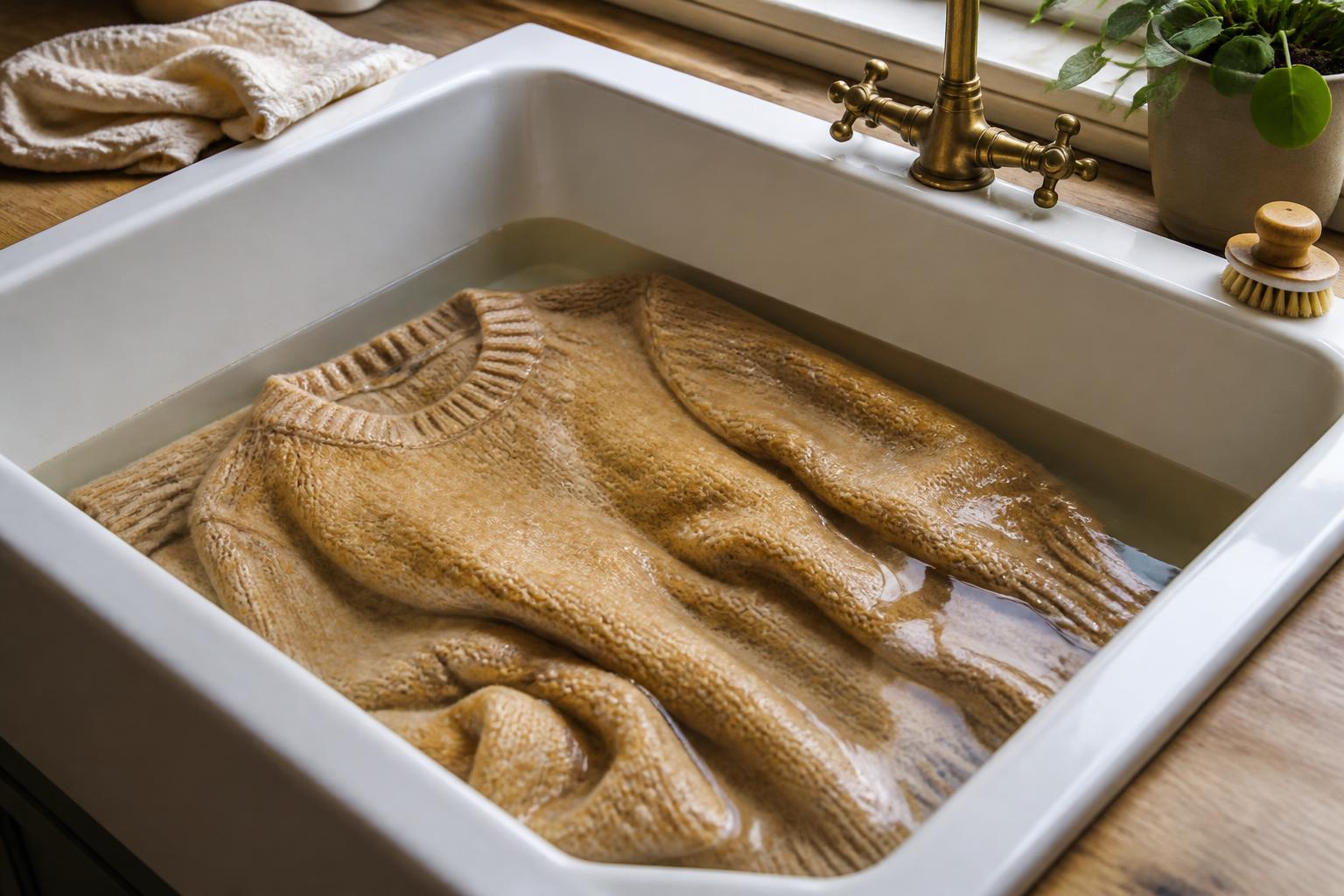
First, fill the basin with lukewarm water. In practical terms, think body temperature or slightly cooler. Hot water increases the risk of more shrinkage. Add a small amount of wool wash if you have it. If not, a little baby shampoo or a plain hair conditioner can help soften the fibres enough for reshaping. Do not pour product straight onto the jumper.
Lower the jumper into the water and press it down gently so it becomes evenly wet. Do not rub, wring or swish it around. Leave it to soak for around 10 to 20 minutes. That is usually enough for the fibres to relax.
When the soaking time is up, support the garment fully with both hands as you lift it out. Wet wool is heavy and can stretch out of shape under its own weight. If you used conditioner or shampoo, rinse lightly in water of a similar temperature. Again, no rubbing and no sudden temperature change.
Next, remove excess water. Lay the jumper flat on a towel, roll the towel up with the jumper inside, and press firmly along the roll. Stand on it if needed. The goal is to blot out moisture, not twist it out. If the towel becomes soaked, repeat with a second dry one.
Now comes the reshaping. Spread the jumper on a fresh dry towel or a mesh drying rack. Smooth it into a rough jumper shape first, shoulders straight, sleeves aligned, side seams even.
Then work section by section:
-
Neckline and shoulders
Gently pat these back into a neat shape. Do not stretch the neckline aggressively or it can become wavy. -
Body width
Place your hands inside the side edges and ease the fabric outward a little at a time. Think of persuading, not pulling. Keep checking both sides so the jumper stays symmetrical. -
Body length
Hold the shoulder area with one hand and gently draw the hem downward with the other. Move across the width in small sections rather than pulling from one point. -
Sleeves
Ease each sleeve lengthwise from shoulder to cuff. Then adjust width if needed. If one sleeve has shrunk more than the other, compare them constantly. -
Ribbing at cuffs and hem
Rib often contracts more than the main fabric. Stretch it only enough to match the body, not beyond it.
If you know the original measurements, use them. If you do not, compare the jumper to one that fits similarly, or measure your own chest width, body length and sleeve length against it. A tape measure helps you avoid the common mistake of over-stretching one area while another stays too small.
Pinning can help, but only lightly. If you use pins, place them through the towel at the outer edge of the garment to hold shape, not by stabbing through delicate yarn under tension. For many jumpers, careful smoothing and regular checking is enough.
One attempt is usually safer than repeated soaking and stretching. If the jumper responds, you will see some give while it is damp. If it fights you at every point and springs back immediately, that is a sign the shrinkage is more permanent.
How to dry it without shrinking it again
Drying is where a lot of good rescue work is undone.
Never hang a wet or damp wool jumper to dry. The weight of the water can drag it out in some places and tighten it in others. Avoid the tumble dryer completely, even on a low setting. Also keep it away from a radiator, heated airer bar, direct sunlight on a hot windowsill, or any concentrated heat source.
Instead, dry it flat in a well-ventilated room.
Once you have reshaped the jumper, measure it. Note the chest width from underarm to underarm, the body length from shoulder to hem, and the sleeve length from shoulder seam to cuff, or from underarm if that suits the knit better. This matters because damp wool can creep back as it dries. If you know the target shape, you can correct small changes before they set.
Check it after the first hour or two, then a few times over the drying period. If the hem has drawn in or a sleeve has shortened slightly, ease it back again while still damp. Small adjustments are more effective than one big tug at the end.
If the towel underneath becomes very damp, move the jumper onto a dry one, lifting it with full support. Slide your forearms under as much of the garment as possible rather than picking it up from the shoulders or hem.
A mesh drying rack is handy because air can circulate underneath, but a towel on a bed, table or clean floor works perfectly well. The important thing is that the surface is flat and the jumper is not disturbed too much while wet.
Expect drying to take time. Thick wool can need a full day or longer in a cool UK home, especially in winter. That is normal. Rushing it with heat is what causes trouble.
Once fully dry, try it on over a thin T-shirt rather than bare skin. That makes it easier to assess fit without forcing the knit. If it is close but still a touch snug, wearing it briefly can help the fibres settle into shape. If it already feels strained, take it off rather than trying to “wear it bigger”.
To reduce the chances of going through this again, it helps to wash wool less often and more carefully in the first place. Our guide on how often to wash wool jumpers covers what really needs laundering and what usually does not.
When to stop and what to do if it is still too small
It is worth trying to rescue a mildly shrunken jumper. It is not worth destroying it through persistence.
Stop if:
- The fabric is becoming distorted rather than larger
- The shoulders or neckline are losing shape
- You hear fibres straining or see stitches opening
- The knit still feels dense and compact after soaking
- The jumper has improved as much as it is likely to
A second careful blocking attempt may help a little if the first one made some difference. Beyond that, repeated wetting and stretching usually gives diminishing returns. Wool can weaken when handled over and over, especially finer knits.
If the jumper is still too small, the realistic next steps depend on how far off it is.
If it is only slightly snug, keep it as a layering piece. Many jumpers that no longer work over a shirt still work over a vest or thin tee.
If the body is fine but the sleeves are short, a knitwear repair specialist may be able to alter cuffs or add a neat contrast extension, though this is not possible on every knit. Ask for a clear explanation of what can be done before you pay for any work.
If the jumper has become child-sized or generally too tight, repurposing is often better than leaving it unworn. Felted or partly felted wool can make excellent mittens, hot water bottle covers, cushion fronts or draft excluders. If the surface has gone bobbly from the whole episode, you can tidy it up afterwards with the right method, as we explain in our guide to removing bobbles from jumpers without damaging the knit.
If the jumper is valuable, sentimental or part of a work wardrobe you rely on, specialist help is worth considering. Look for a cleaner or knitwear repair service that talks specifically about blocking, reconditioning or wool restoration. Standard counter service that only offers “dry cleaning” may not be enough.
The main thing is not to treat a shrunken wool jumper as ruined the moment it comes out small, or as fully recoverable when it clearly is not. Some wool garments do come back surprisingly well with a careful soak and reshape. Others have crossed into felting and will never return to their original size. Knowing the difference saves time, frustration and a lot of accidental damage.
If you are trying to work out how to unshrink a wool jumper at home, the best approach is simple. Check the label, judge honestly whether the knit is merely tightened or truly felted, then rehydrate, support and reshape with patience. You may not get every centimetre back, but you can often recover enough to keep a useful jumper in your wardrobe and out of the textile waste pile.

Questions about this article or a correction to suggest? Get in touch. Read more about our editorial approach.