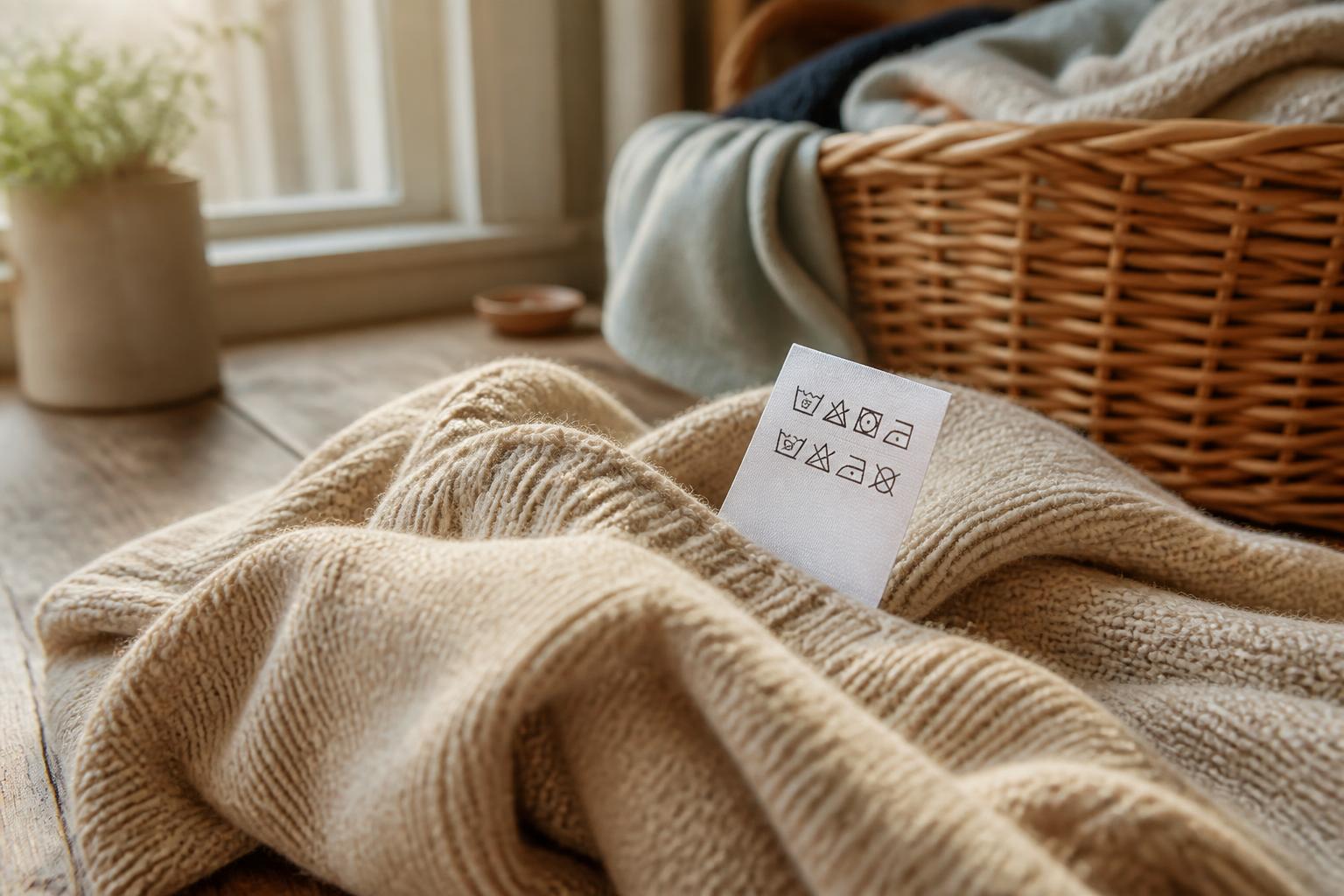
Care labels look cryptic until you know the pattern. Once you do, you can usually scan a label in a few seconds and avoid the common mistakes that shrink knitwear, crack prints, dull colours or twist seams out of shape. The quickest way to read them is to look for the five main groups in order: washing, bleaching, drying, ironing and professional cleaning.
The important thing to remember is that the label on the garment takes priority over general advice about the fibre. Cotton is not always washable at 40°C, wool is not always hand wash only, and “delicate” on a shop tag is not a care instruction. The actual symbols are the instruction. If you buy a lot of second-hand clothing, or you are trying to make things last rather than replacing them, learning these Fabric care symbols is one of the most useful wardrobe skills to have.
What fabric care symbols are actually telling you
Care symbols exist because fibre content alone does not tell you enough about how a garment should be cleaned. Two tops can both be 100% cotton and need different treatment because of dye, weave, finish, lining, interfacing, embroidery, print, shrinkage allowance or construction. A tailored cotton shirt with fusible collar pieces is not the same as a simple cotton T-shirt. A viscose dress with a lining and covered buttons is not the same as a plain viscose blouse.
On most labels, the symbols are grouped in a standard sequence:
- Wash tub, for washing
- Triangle, for bleaching
- Square, for drying
- Iron, for ironing
- Circle, for professional dry cleaning or wet cleaning
That order matters because it lets you scan quickly. You do not need to memorise every variant on day one. You need to know what each shape controls, then what the extra marks mean.
In the UK, garments generally use the same symbol system you will see across Europe. You may also see written instructions alongside the symbols, especially on older labels or imported items. If the words and the symbols appear to conflict, treat the more restrictive instruction as the safer one. For example, if a label shows a wash tub at 30°C but also says “wash separately” or “reshape while damp”, those extra notes are not optional.
Manufacturer instructions matter more than broad fabric rules because they are set for that specific item. That is particularly important with:
- coated fabrics
- bonded fabrics
- garments with elastane
- printed sweatshirts and T-shirts
- pleated items
- wool blends
- lined jackets and skirts
- embellished or sequinned pieces
- bras, sportswear and compression garments
If you want a practical system for making clothes last beyond the wash itself, our guide to keeping a smaller wardrobe in regular use and our advice on buying second-hand without bringing home extra problems fit neatly alongside label reading.
How to read the five main symbol groups at a glance
Once you know the basic shapes, the extra marks are straightforward.
1. The wash tub
The tub symbol covers machine washing or hand washing.
- A plain tub means the item can be washed.
- A number inside the tub is the maximum wash temperature, usually 30, 40, 50 or 60.
- A hand in the tub means hand wash.
- A crossed-out tub means do not wash.
Under the tub, you may see bars.
- No bar means a normal cycle.
- One bar means reduced agitation, often called permanent press or easy care.
- Two bars mean a very gentle process, usually for delicates.
Dots are less common in UK care labels for washing temperature than actual numbers, but if they appear, more dots mean more heat.
2. The triangle
The triangle is about bleach.
- A plain triangle means bleaching is allowed.
- A crossed-out triangle means do not bleach.
- A triangle with diagonal lines usually means only oxygen bleach, not chlorine bleach.
For most everyday wardrobes, the safest default is not to bleach unless you specifically need to and the label allows it. Bleach mistakes are usually permanent.
3. The square
The square covers drying. This is one of the most easily misread groups because it includes several different methods.
- A square with a circle inside is tumble drying.
- A plain square with lines inside it refers to natural drying, such as line dry or flat dry.
- A crossed-out symbol means do not use that drying method.
Again, bars under the square can indicate a gentler process.
4. The iron
The iron symbol tells you whether ironing is allowed and how hot.
- One dot means low heat.
- Two dots mean medium heat.
- Three dots mean high heat.
- A crossed-out iron means do not iron.
If there are crossed-out steam lines under the iron, avoid steam.
5. The circle
The circle is for professional cleaning.
- A plain circle means professional dry cleaning may be suitable.
- Letters inside the circle tell a professional cleaner which solvents or wet cleaning methods are appropriate.
- A crossed-out circle means do not dry clean.
Most of us do not need to decode every cleaning letter ourselves, but it is useful to know that the circle is not for home washing decisions. It is there for the cleaner.
What crosses, dots and underlines change
These small marks do most of the work.
- Crosses mean do not do this.
- Dots usually indicate heat level.
- Underlines or bars usually mean reduce the mechanical action, use a gentler cycle, or treat the item more carefully.
If you remember only one thing, remember this: the shape tells you the category, the extra marks tell you the level of caution.
The washing symbols that most often cause mistakes
Some symbols are simple on paper and still cause trouble in real laundry baskets.
Hand wash does not mean “fine on any gentle machine cycle”
A hand wash symbol means the maker wants minimal agitation and close control over temperature. Some modern washing machines have a hand wash or wool setting that can be gentler than actual hand washing, but do not assume that any delicate cycle is equivalent. Check your machine manual. If in doubt, cool water, minimal rubbing, and support the garment when lifting it out are safer.
This matters especially for knitwear, bras, embellished tops and older second-hand pieces whose seams may already be stressed.
Do not wash really does mean do not wash
A crossed-out tub is one of the symbols people most often ignore, especially on tailoring or occasionwear. Sometimes the garment may survive a careful hand wash. Sometimes it will not. Interfacing can bubble, dyes can run, linings can distort and structured areas can collapse. If the garment matters, follow the label or test a hidden area only if you are prepared for loss.
30°C versus 40°C is not a trivial difference
On everyday laundry, many people treat 30°C and 40°C as interchangeable. They are not. A 30°C maximum is often there to limit shrinkage, colour loss, print damage or fibre stress. A garment that looks sturdy can still be labelled 30°C because of finish or construction.
If the label says 30°C, we would not “round up” to 40°C for convenience. If you need better stain removal, pre-treat the stain and extend wash time rather than increasing the temperature against the label.
Permanent press and easy care need less agitation
A single bar under the wash tub usually means a reduced-action cycle. On UK machines, this often aligns with synthetic, easy-iron or permanent press settings, depending on the brand. It is designed to reduce creasing and stress. That is useful for shirts, blouses, polyester blends and anything prone to coming out crumpled or twisted.
Delicate means more than a lower spin
Two bars under the tub indicate a very mild wash. People often think “delicate” just means cooler water or a laundry bag. It also means less movement, less friction and often a smaller load. If you cram delicates into a full drum, the cycle setting cannot compensate.
Spin limits matter
Some labels include a wash symbol that implies gentle handling, even if they do not state a spin speed in writing. High spin can stretch knitwear, crease shirts badly, stress seams and leave underwired bras misshapen. If a garment is hand wash, wool, viscose, embellished or loosely knitted, reducing the spin is often wise even where the label does not spell it out.
Drying and ironing symbols that can quietly damage clothes
A lot of clothing damage happens after the wash, not during it. Drying and ironing are where shape, finish and surface texture can be lost without much warning.
Tumble drying is convenient, but not neutral
The square with a circle inside refers to tumble drying.
- One dot means low heat.
- Two dots mean normal heat.
- A crossed-out symbol means do not tumble dry.
Heat and tumbling can shrink cotton, felt wool, weaken elastane, age prints and cause pilling through friction. Even if a label allows tumble drying, line drying can still be the gentler option for garments you want to keep looking good for longer. We tend to reserve tumble drying for items that need softness or speed, not as the default for every load.
Line drying can protect fibres, but placement matters
A square with a vertical line usually means line dry. That is often ideal for shirts, many cotton items and sturdy synthetics. But line drying heavy knitwear can stretch it, and direct sun can fade dark colours or bright dyes. If the item is dark, printed or known to fade, dry it inside out and out of harsh sunlight where possible.
Flat drying helps garments hold their shape
A square with a horizontal line means dry flat. This is common for knitwear and anything that can stretch under its own weight when wet. If you hang a soaked wool jumper that should be dried flat, you can end up with a longer body, dropped shoulders or a distorted neckline even if the wash itself went fine.
Reshaping while damp is often just as important as the drying method. Smooth seams, align side seams, straighten plackets and lay the garment to its intended size.
Drip dry and shade dry are worth noticing
Some labels specify drip dry or dry in the shade. Drip dry means allow the item to hang wet so water can drain naturally, often with no wringing. Shade drying matters for fabrics or dyes that are sensitive to sun. These details can seem fussy until you ruin a dark viscose dress or a bright printed top.
Iron heat symbols protect more than just the surface
The iron symbol is not only about avoiding scorch marks.
- Low heat is safest for synthetics, acetate, many linings and printed fabrics.
- Medium heat often suits wool and polyester blends, usually with a pressing cloth if the surface is delicate.
- High heat is generally for robust cotton or linen, but only if the label allows it.
Too much heat can melt synthetic fibres, flatten texture, leave shine on dark fabrics, crack prints and mark seam allowances through the outer fabric. If a garment has a print, coating, pleat or textured finish, iron it inside out or use a cloth, even if the label allows ironing.
What to do if the label is missing, faded or unclear
This is common with second-hand clothing, vintage items and older basics. If the care label cannot be relied on, the safest approach is to work from risk, not hope.
Step 1, identify the fibre as best you can
Check any fibre content label that remains. If that is gone too, use touch and behaviour as clues, but stay cautious. Wool usually feels warm and springy, linen has a crisp slub, silk often has a soft sheen, and synthetics can feel smoother or cooler. Blends are harder to judge.
Step 2, look at construction, not just fabric
Ask what could fail.
- Is there a lining?
- Is there interfacing in collars, cuffs or waistbands?
- Are there prints, beads, sequins or glued trims?
- Is the knit loose?
- Are the colours strong or contrasting?
- Does the garment feel as if it has a finish or coating?
The more complex the construction, the more cautious we would be.
Step 3, choose the gentlest plausible method
If you cannot confirm the label, start lower risk.
- cool or lukewarm water
- mild detergent
- minimal agitation
- short wash time
- no tumble drying
- low or no spin
- air dry away from strong heat or sun
For a sturdy cotton tee from a charity shop, that may still mean a machine wash at 30°C. For a lined skirt or tailored jacket, it may mean spot cleaning first and delaying a full wash until necessary.
Step 4, test for colour run
Dampen an inside seam or hem with water and press with a white cloth. If dye transfers, wash separately, in cold water, or reconsider whether washing is wise at all.
Step 5, spot clean first if the issue is local
If there is one mark on a garment, a full wash may be more damaging than careful spot cleaning. This is especially true for wool coats, structured items and pieces that are not genuinely dirty overall.
Step 6, dry with shape in mind
When uncertain, avoid the tumble dryer. Support knitwear flat. Hang shirts neatly. Reshape collars, cuffs and hems before the item dries.
If second-hand shopping is part of how you build a practical wardrobe, our guide to checking garments properly before you buy can save you from bringing home pieces that are already one wash away from trouble.
How to use care labels to keep clothes in use for longer
Reading care labels is not about becoming precious with every sock. It is about matching the right level of care to the garment, so clothes stay wearable for longer and you spend less replacing things early.
Sort by more than colour
A better sort is:
- heavy versus light fabrics
- lint-givers versus lint-attractors
- sturdy versus delicate
- hot wash items versus cool wash items
That stops jeans abrading shirts, towels roughing up knitwear and zips snagging finer fabrics.
Wash less often where appropriate
Not every worn item needs a full wash after one use. Trousers, jumpers, overshirts and some dresses often benefit from airing, spot cleaning or steaming instead. Overwashing causes fading, fibre wear and shape loss. Labels help here because they tell you which items are more vulnerable and worth treating gently.
Use the gentlest effective setting
If the label allows 40°C, you do not always need 40°C. If the item can be tumble dried, you do not always need to tumble dry it. The label gives you the ceiling, not the requirement. For many clothes, using less heat and less friction pays off in appearance and lifespan.
Treat repairs as part of care
A loose hem, missing button or small seam split is easier to fix before washing turns it into a larger problem. Labels help because they tell you how much stress a garment can take. A delicate blouse with a partly open seam should not be thrown into a normal mixed wash and hoped for the best.
Build buying habits around realistic care
Care labels are useful before purchase too. If you know you will not hand wash a blouse or steam a pleated skirt, it may not be a practical buy for your life, however good the bargain looks. For a wardrobe that actually gets worn, realistic care requirements matter as much as style.
Keep the label if you can
If a label is scratchy, some people cut it out immediately. Before doing that, take a photo and save it in your phone. That is particularly useful for coats, knitwear, bras, occasionwear and anything second-hand that may already have limited information attached.
Fabric care symbols are not there to make laundry complicated. They are there to help you avoid preventable damage. Once you know the shapes and the few marks that modify them, you can read most labels quickly, make better wash decisions, and keep everyday clothes in service longer with less guesswork.

Questions about this article or a correction to suggest? Get in touch. Read more about our editorial approach.